
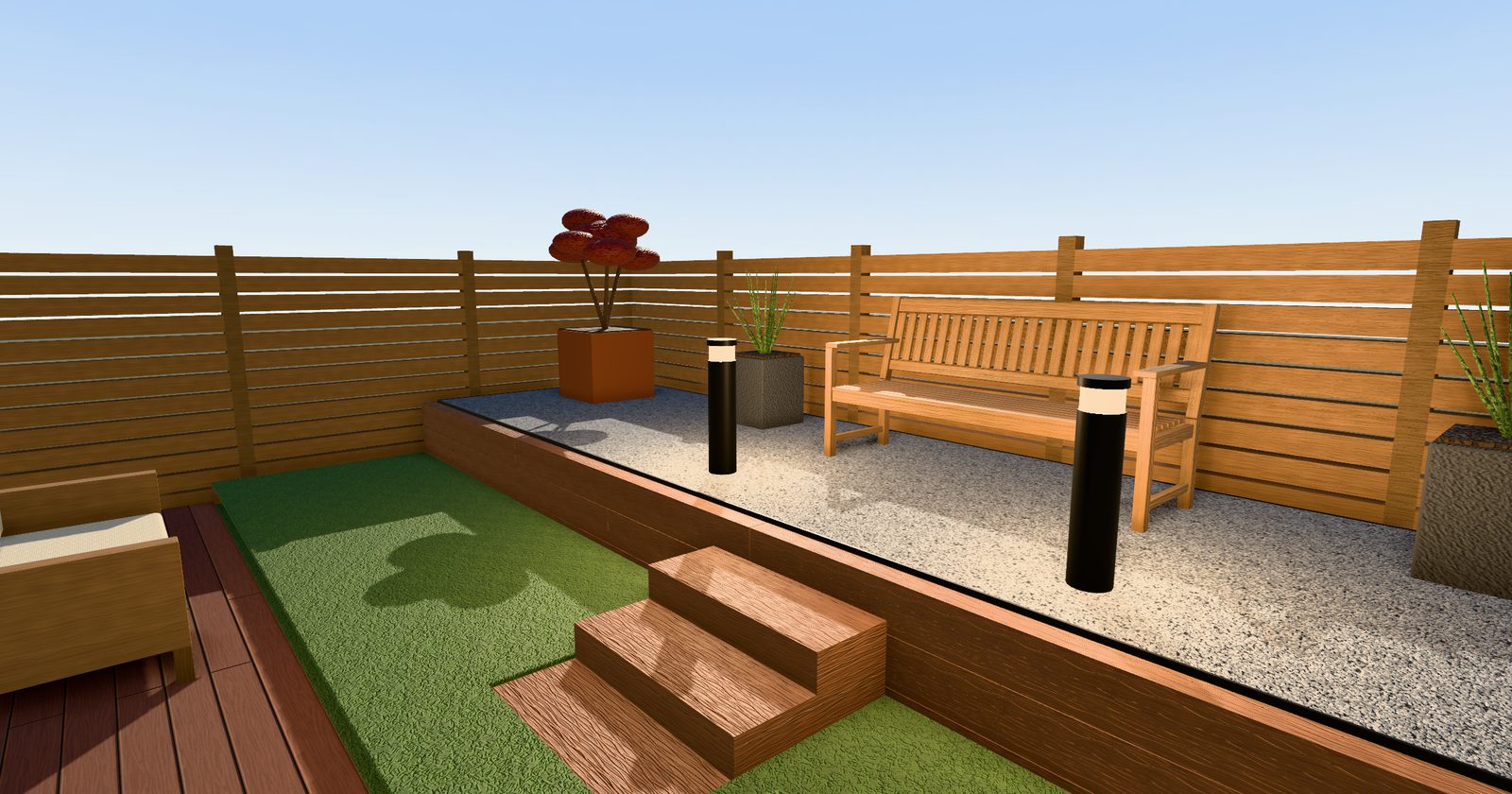
Sleepers or concrete blocks for a retaining wall?
"Wood," said the client in March
At the first meeting the client wanted the raised back of the garden held up by wood: warmer than concrete, they said, and it goes with the fence. In May the sleepers are stacked on the drive, and the client walks past them and asks whether it will look like a farmyard. You can still change the order. You cannot get back the week.
Most clients choose a retaining wall from a photo of someone else's garden, or from a sample on your desk. Neither shows them their own garden with three courses of it along the lawn. This post sets the two most common low retaining walls side by side, with the numbers you need to order them, and shows how to let the client choose by walking past both in Duimstok.
The two walls in numbers
Shops in most countries sell both, in sizes close to these. They are the two types Duimstok 1.0.5 builds:
- Concrete block: faces 40 × 20 cm, 20 cm deep. Each course is 20 cm high, and each course is set half a block along from the one below, so the joints never line up.
- Timber sleeper: 2.40 m long, 20 cm high on edge, 10 cm thick. Again 20 cm a course, and the joints are staggered by half a sleeper, 1.20 m.
Both stack in 20 cm courses, so a 60 cm level is three courses either way. Duimstok lays them from the top down, so the top course is always whole and the bottom course is the part that is not buried. Below ground you still need whatever footing the site asks for; no drawing knows your soil.
How many you order for a 9.1 m wall
The garden in these pictures is 9.1 m wide, and its back 2.1 m is raised 60 cm. The front of that level, the side you see from the house, is one straight wall 9.1 m long and three courses high.
- Blocks: 9.1 m ÷ 0.40 m = 22.75, so 23 blocks a course with one cut, times three courses: 69 blocks.
- Sleepers: 9.1 m ÷ 2.40 m = 3.8, so four a course with one cut to 1.90 m, times three: 12 sleepers. Reuse the offcuts and you need 11.4, which is still 12.
Count the sides of the level too. Duimstok walls every side, from the low ground to the high, because that is what holds the soil in; here that is the back and the two short sides against the fences as well. Duimstok does not put the wall in its quantities list yet, so this arithmetic is yours to do. It takes a minute once the level is drawn at its real size.
What the thickness costs you on top
A retaining wall stands inside a raised level, its outer face on the line you drew. So the wall's thickness comes off the flat top, on every side. On this 2.1 m deep level, blocks on both long sides leave 1.70 m of gravel; sleepers leave 1.90 m. Twenty centimetres sounds like nothing until a 65 cm deep bench and somebody's legs have to fit in front of it.
The look, and the steps that come with it
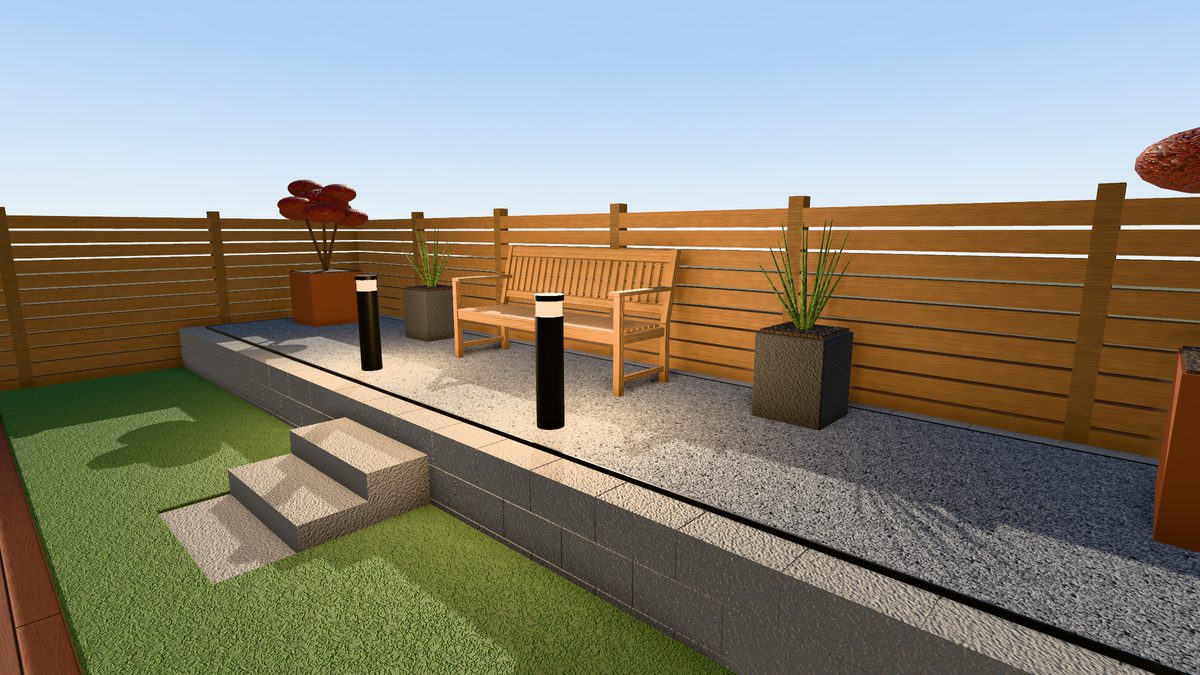
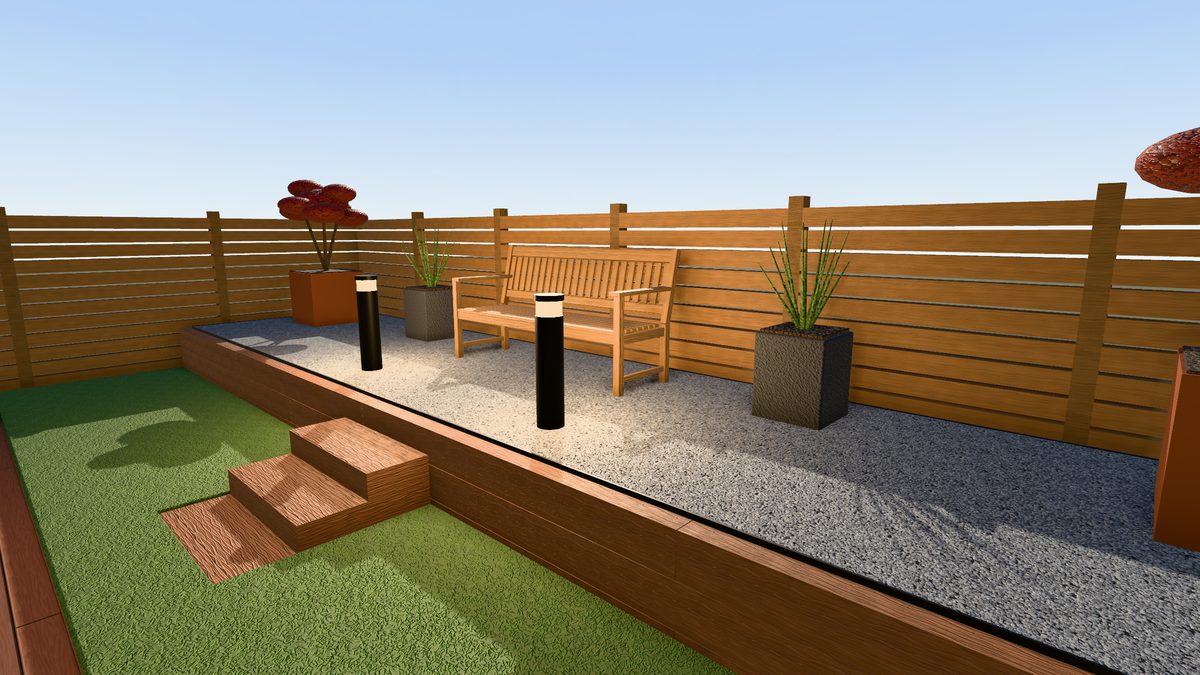
Seen from the deck the difference is bigger than on a sample. Blocks read as a crisp grey band with a fine grid of joints; sleepers read as three long warm lines that pick up the fence. In Duimstok the steps up to the level are built in the wall's own finish too, concrete treads with a block wall and timber treads with sleepers, so the client sees the whole thing change at once.
Durability belongs in the same conversation. Softwood sleepers in wet soil weather and rot sooner than oak, and both move more than concrete. That is a judgement for you and the client to make on the site's conditions; what the model gives you is the look, at the size it will be.
Let the client choose by walking past
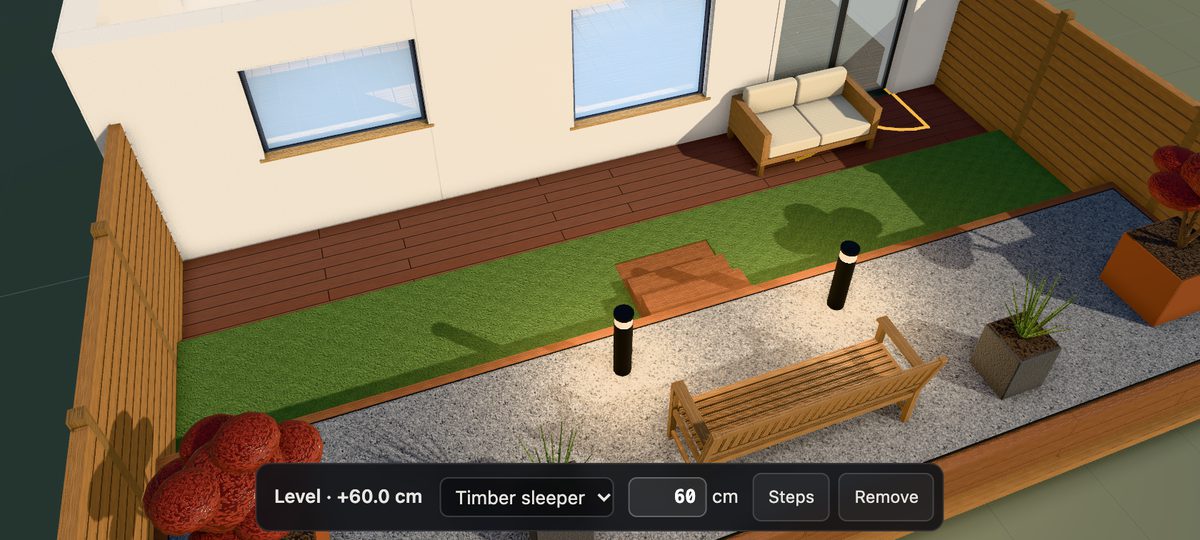
Select the level from above and the bar shows its wall in a menu. Switch it and the wall is rebuilt in a moment, course by course. Then double-click the lawn and walk along it with the client, or stand where they will sit on the deck. Switch back and forth as often as they like; ⌘ Z undoes it.
Try it
- Press O for the view from above, then Level on the toolbar.
- Type the height on the bar, for example 60 cm, and press T until the bar shows the wall you want: Concrete block or Timber sleeper.
- Drag out the area, then select the level and press Steps and click a side.
- With the level selected, pick the other wall in the bar's menu, and double-click the lawn to walk past it.
Limits worth knowing
- Two wall types so far. Gabions, L-shaped concrete elements and copings are not built yet.
- Outlines are straight-sided; a curved wall is not there yet.
- Over 1 m the app warns that most rules want a railing and an engineer for the wall. It does not design the wall's footing or drainage.
Questions people ask
How many sleepers do I need for a 60 cm retaining wall?
Three courses of 20 cm sleepers on edge. For each course, divide the wall's length by 2.40 m and round up; a 9.1 m wall takes 12.
Are concrete blocks or sleepers better for a retaining wall?
Blocks do not rot and give a crisp edge; sleepers are quicker to lay and look warmer. Both come in 20 cm courses, so the height is the same either way.
Does the wall take space from the raised area?
Yes. It stands inside the level, so its thickness comes off the top on every side: 20 cm for blocks, 10 cm for sleepers.