
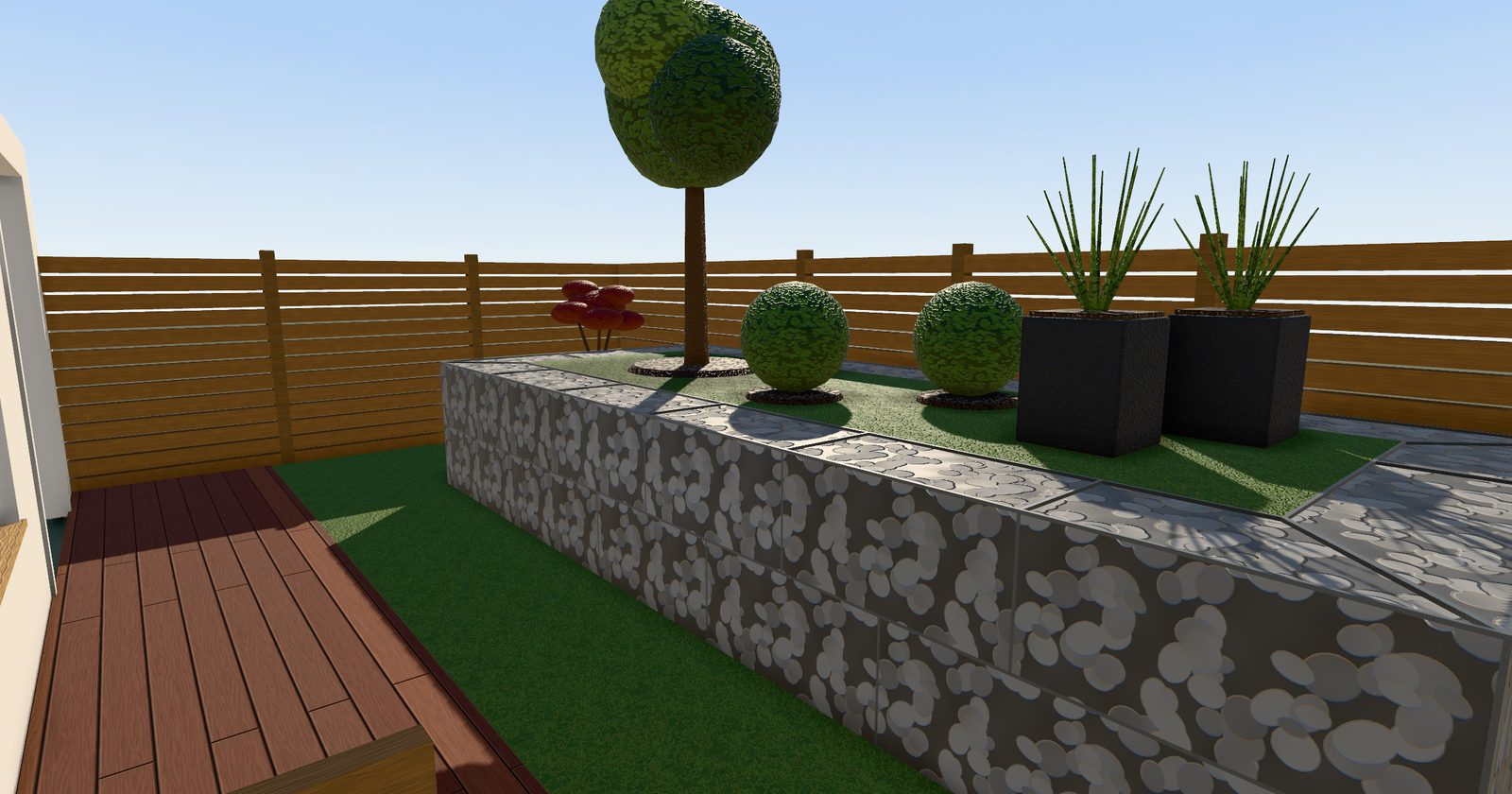
How many gabion baskets does a retaining wall need?
The lorry that came back for the rest
The quote said gabions along the back, a metre high, and you priced them by the metre of wall. On site the baskets go up quickly. The stone does not: the first load runs out with a corner and both returns still empty, and the second lorry is a day away and not in the price.
A gabion wall is bought by the basket and filled by the tonne, and both follow from its length, its height and every side it runs along. This post counts both for a real example, shows what the 50 cm thickness costs the space on top, and shows how to set it in front of your client in Duimstok, which builds gabion retaining walls since version 1.0.7.
The basket everything follows from
The common retaining basket in mainland Europe, the UK and Australia is 1.00 m long, 0.50 m high and 0.50 m deep: a quarter of a cubic metre of stone in welded mesh. Baskets are stacked like bricks, each course set half a basket along from the one below, so a wall is built in 50 cm courses and every second course starts and ends with a half basket. Many suppliers sell a 1.00 × 0.50 × 0.50 m and a 0.50 × 0.50 × 0.50 m size for exactly that.
So a wall 1.0 m high is two courses, and the arithmetic is the same for every metre of it: two baskets per metre run, half a cubic metre of stone.
Count a real wall: a bank 6.0 by 2.5 m
The garden in these pictures has a planted bank at the back, raised 1.0 m, 6.0 m wide and 2.5 m deep to the back fence. Select it from above and the bar says exactly that: Gabion basket, Grey, 100 cm high, 600 × 250 cm.
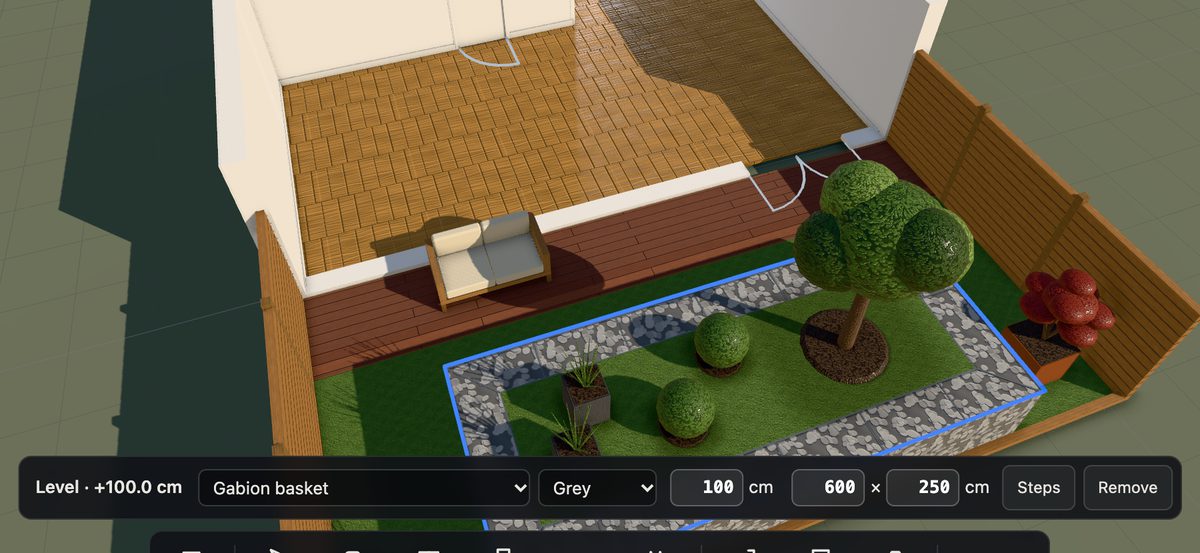
The wall runs along every side where the ground drops, and stands inside the line, so the baskets on the short sides fit between the front and back runs:
- Front: 6.0 m, six baskets a course.
- Back: another 6.0 m, six a course, if the ground behind the fence is lower.
- Each side: 2.5 m less 0.5 m at each end, so 1.5 m: a basket and a half a course.
That is 6 + 6 + 1.5 + 1.5 = 15 baskets' worth a course, and with two courses 30 baskets' worth: in practice 26 whole baskets and 8 halves, once the stagger is laid out. At 0.25 m³ each that is 7.5 m³ of stone.
If the neighbour's ground behind the back fence is as high as the bank, you need no back run. Then it is front and sides only, 6.0 + 2.0 + 2.0 = 10 baskets' worth a course, 20 in all, and 5.0 m³ of stone.
From cubic metres to tonnes
Gabion stone is sold by the tonne. Packed into a basket, stone of the usual 60 to 90 mm or 80 to 120 mm grades weighs roughly 1.6 to 1.7 tonnes per cubic metre, because about a third of the volume is the gaps between stones. Ask your supplier for their figure; it depends on the rock.
- 7.5 m³ × 1.6 t = about 12 tonnes for the bank walled all round.
- 5.0 m³ × 1.6 t = about 8 tonnes without the back run.
That is the difference between one delivery and two, which is worth knowing before the quote goes out, not on the morning the first load runs out.
What 50 cm of wall takes off the top
Gabions are the thickest retaining wall there is: 50 cm, against 20 cm for concrete blocks and 10 cm for sleepers. Because the wall stands inside the bank, that comes off the flat top on every walled side. This 6.0 × 2.5 m bank keeps 5.0 × 1.5 m of soil to plant, 7.5 m² out of the 15 m² you drew. With concrete blocks it would keep 5.6 × 2.1 m, almost 11.8 m².
The top of the baskets is a ledge, too, half a metre deep at a metre high: a place to sit. Some clients want gabions for exactly that.
Let the client pick the fill
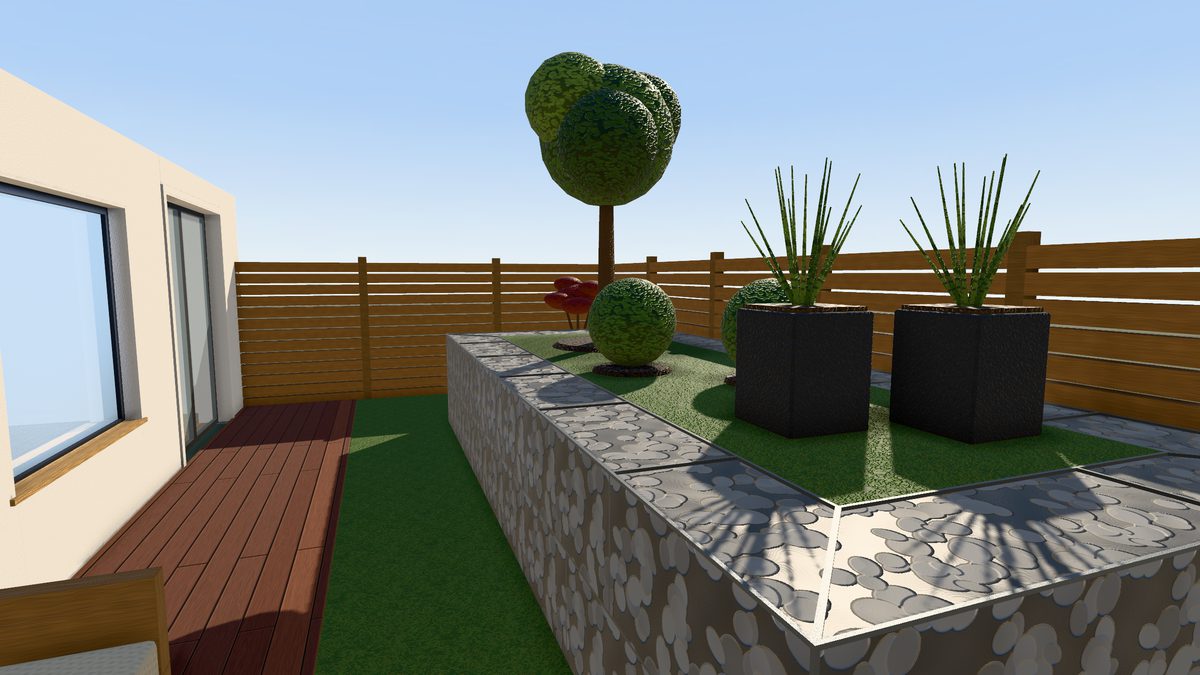
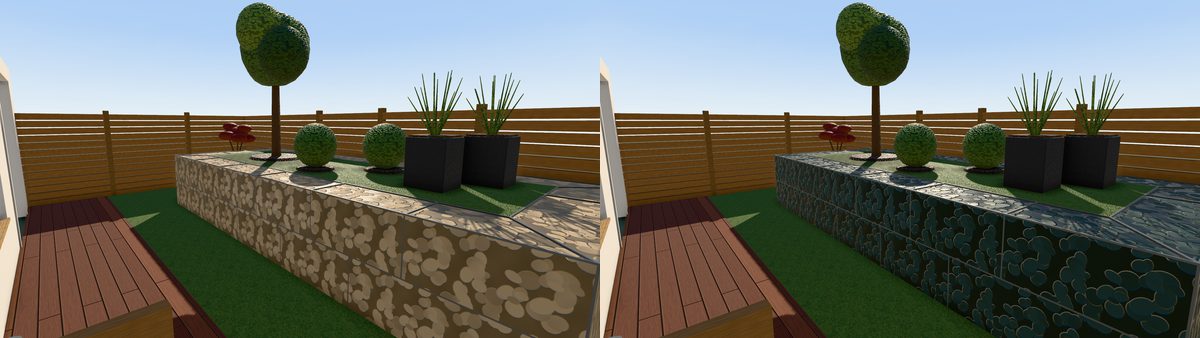
The fill changes the wall more than any sample shows. Duimstok builds the baskets in three fills sold for retaining walls: grey limestone or granite, yellow sandstone, and dark pebbles. With the bank selected, the colour is a menu on the bar; change it and walk past the wall again.
Try it
- Press O for the view from above, then Level on the toolbar.
- Type the height on the bar, 100 cm, and press T until the Retaining wall menu shows Gabion basket.
- Drag out the bank, or click once and type its size on the bar.
- Select it to read its height and size, and choose Grey, Yellow or Dark grey.
- Double-click the lawn and walk along the wall with your client.
Limits worth knowing
- The baskets are not in the quantities list yet; count them from the size on the bar, as above.
- It does not choose the stone grade or the mesh gauge for you; those are your supplier's call.
- Over 1 m most rules want a railing on top and an engineer for the wall. The app draws the wall, not its foundation, geotextile or drainage.
Questions people ask
How many gabion baskets do I need for a 1 m high wall?
With 1.00 × 0.50 × 0.50 m baskets, two per metre of wall: two courses of one basket per metre. A 6 m wall takes 12 baskets' worth, laid as whole baskets and halves on the stagger.
How much stone do I need to fill a gabion basket?
A 1.00 × 0.50 × 0.50 m basket holds 0.25 m³, about 0.4 tonnes of stone at a typical 1.6 t/m³.
How thick is a gabion retaining wall?
Usually 50 cm for a low wall, the depth of one basket. Higher walls are often built wider at the bottom, which needs an engineer's design.