
Raised terrace, lost privacy: how high must the screen be?
The terrace is finished and the fence has shrunk
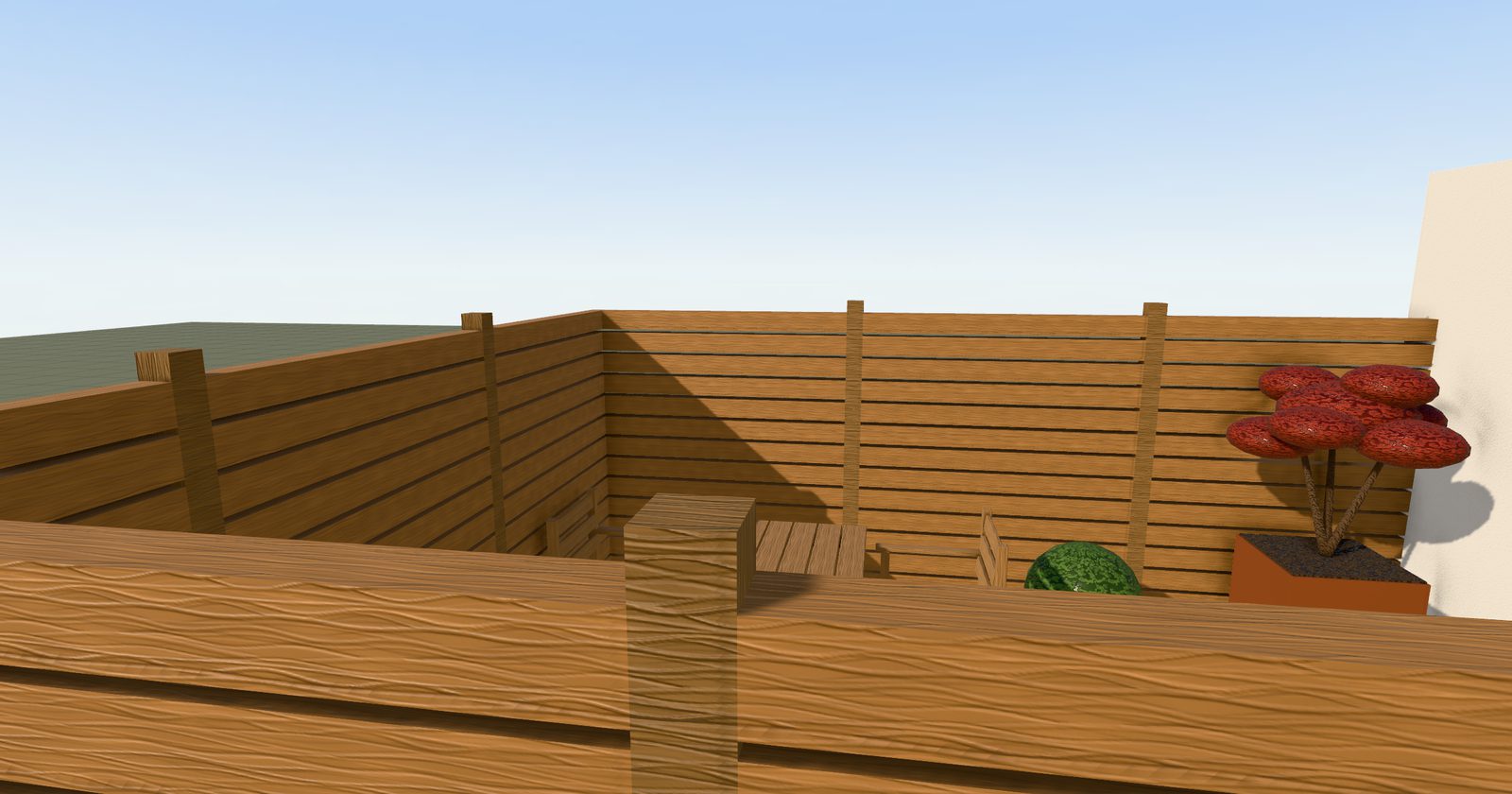
The job went well. The corner of the garden that never dried out is now a terrace, raised 45 cm on a block wall, decked, with two steps up from the lawn. The client carries the first tray of coffee up, puts it down, straightens, and looks the neighbour in the eye. The fence is the same 1.80 m it was last week. It just stops at the client's collarbone now.
Nobody drew that. The plan showed a terrace and a fence, both correct. What it did not show is that raising the floor lowers every fence around it by the same amount. This is the sum, and a way to stand on the terrace before the first block is laid.
The sum: eye height plus terrace height
A standing adult's eyes are about 1.65 m above whatever they stand on. On the lawn, a 1.80 m fence tops that by 15 cm, which is why a 1.80 m fence feels private. On a terrace 45 cm up, the same eyes are at 2.10 m. The fence is now 30 cm below eye level.
Sitting is kinder. A seated person's eyes are about 1.20 m above the floor, so on this terrace 1.65 m above the garden: still 15 cm under the fence top. At 60 cm of height a seated eye is level with the fence, and at 75 cm it is over it. So the rule to give a client is short: seated privacy holds until the terrace is about 60 cm up; standing privacy is gone after the first 15 cm.
What they see: 30 cm for every metre
How much of next door is in view depends on where the client stands. The line from the eye over the fence top keeps falling beyond it, by the 30 cm of difference for every distance between the eye and the fence.
- Standing 1 m from the fence, the line falls 30 cm per metre. A seated neighbour's head, at about 1.20 m, is in view from 2 m beyond the fence; their table top, at 75 cm, from 3.5 m.
- Standing 3 m back, it falls 10 cm per metre. The same head comes into view only 6 m beyond the fence, which in most gardens is past their terrace.
It works the other way too. From 3 m on their side, a standing neighbour sees everything on your client's terrace that is more than 1.40 to 1.50 m above the deck: every adult, from the chest up.
Stand on it before you build it
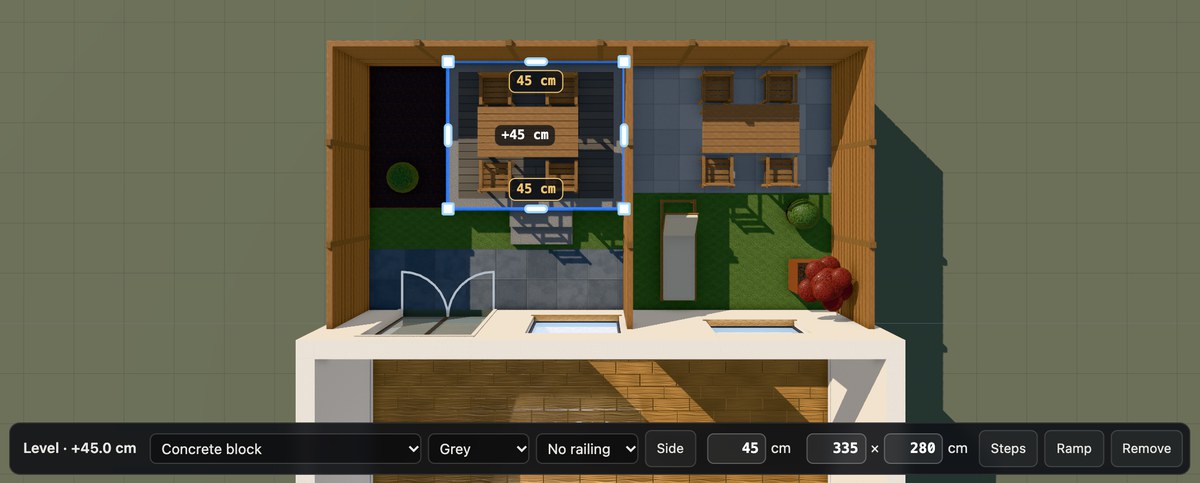
In Duimstok you walk a design with your eyes 1.65 m above the ground you are on, and that includes a raised level. So the check takes a minute. This garden has a 1.80 m slatted fence to the neighbour. The terrace is 3.35 by 2.80 m in the corner against it, drawn with Level and set to 45 cm on the bar.
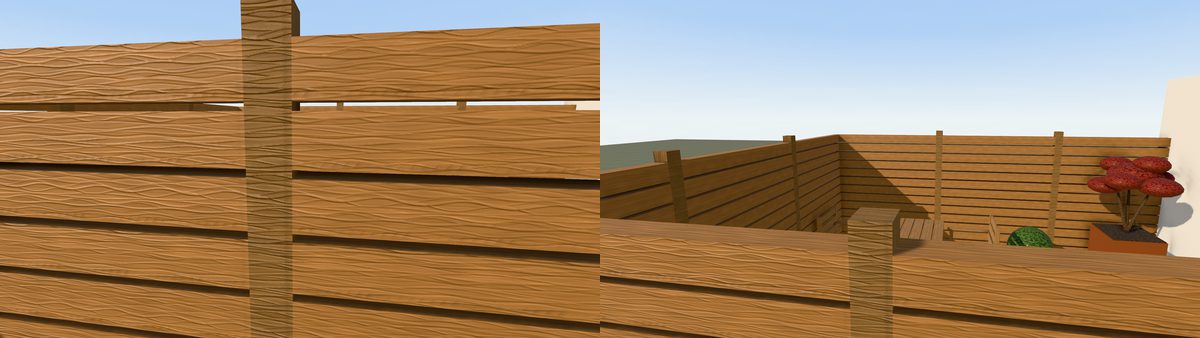
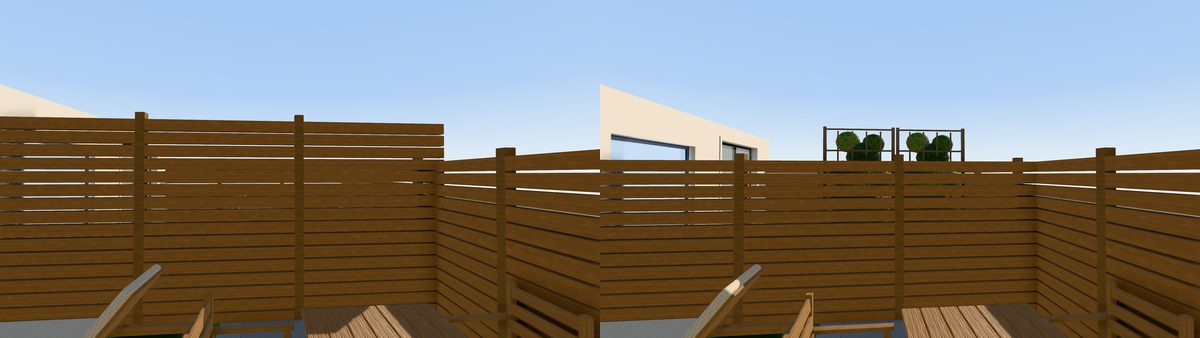
Walk up the steps and turn to the fence. On the left below is the same spot before the raise, with the decking at lawn level: fence, and nothing else. On the right, 65 cm from the fence on the raised terrace: the neighbour's table, 2.3 m beyond it, and most of their garden.
Fix 1: a taller fence, and what next door gets
To hide a standing adult, the screen has to top the terrace by 1.80 m, as the fence tops the lawn. That is the terrace height plus 1.80 m: here 2.25 m from the ground. Type that as the fence's height and the view from the table closes.
Then walk round to the other side. The neighbour, who has no raised terrace, now has 2.25 m of timber along their paving. Before you promise it, check what the municipality allows on a boundary, and show the neighbour that view.
Fix 2: a screen on the terrace, where the table is
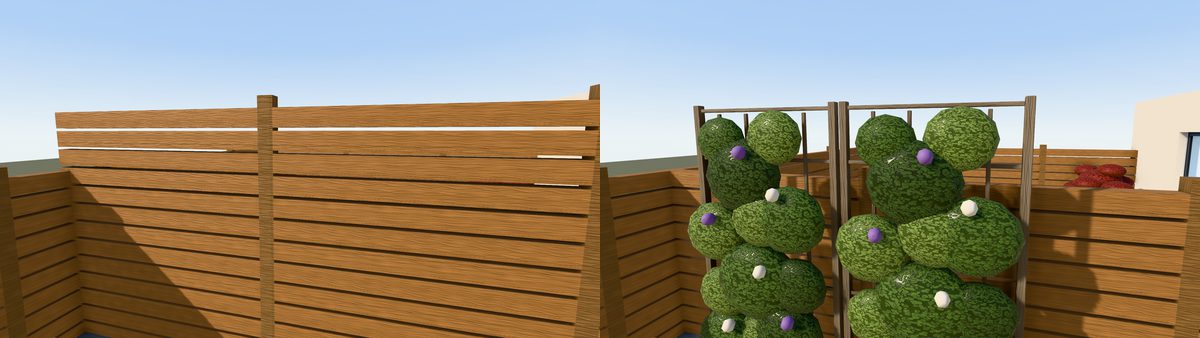
The other way is to leave the boundary alone and screen the seat. A screen that stands on the terrace starts 45 cm up, so 1.80 m of it reaches the same 2.25 m. Here two Climber on Trellis panels, each 90 cm wide and 1.80 m high, stand between the table and the fence: 1.80 m of screen for the four chairs. Past the screen the client can still look over the fence, and that is the trade to talk through: how many panels, and where people actually stand.
Fix 3: lower the terrace
Every 15 cm taken off the terrace gives 15 cm of fence back. At 30 cm the standing eye is 15 cm over the fence, at 15 cm it is level with it. Type the new height on the bar and walk it again; the edge wall, the steps and the soil on Quantities follow. At 45 cm this terrace lists 88 concrete blocks, two steps 1.20 m wide and 3.19 m³ of soil to bring in, so a lower terrace is also a cheaper one.
Make it the client's first view
Since version 1.0.11 you can choose where a walk-through starts: drag the white disc onto the terrace from above and turn it to face the fence. The client opens the design and is standing on the terrace, looking at the fence. They decide about the screen before the quote is signed.
Try it
- Open your plan and press O for the view from above. Draw the terrace with Level and type its height on the bar.
- Press Steps and click the side where the flight goes.
- Press Walk, go up the steps and face the fence. Stand close to it, then at the table.
- For a taller fence: on the start menu choose Edit for your plan, click the fence and type its Height.
- For a screen: open Catalog, search for trellis, choose Climber on Trellis and set the panels down beside the table.
- Walk into the neighbour's side and look back.
Questions people ask
How high should a privacy screen be on a raised terrace or deck?
About 1.80 m above the terrace floor, which is the terrace height plus 1.80 m from the ground: 2.25 m for a terrace 45 cm up. Check the local rule for the boundary before you build a fence that high; a screen standing on the terrace itself is often the easier answer.
Is a 1.8 m fence enough for a raised terrace?
For sitting, yes, as long as the terrace stays under about 60 cm: a seated eye stays below the fence top. For standing, no. A standing adult on any terrace more than 15 cm up looks over a 1.80 m fence.
Does moving the terrace away from the fence help?
It changes what your client sees, not who sees them. Three metres back, the view over the fence only reaches the far end of the neighbour's garden. But a person standing on the terrace is still in view from next door, from the chest up.