
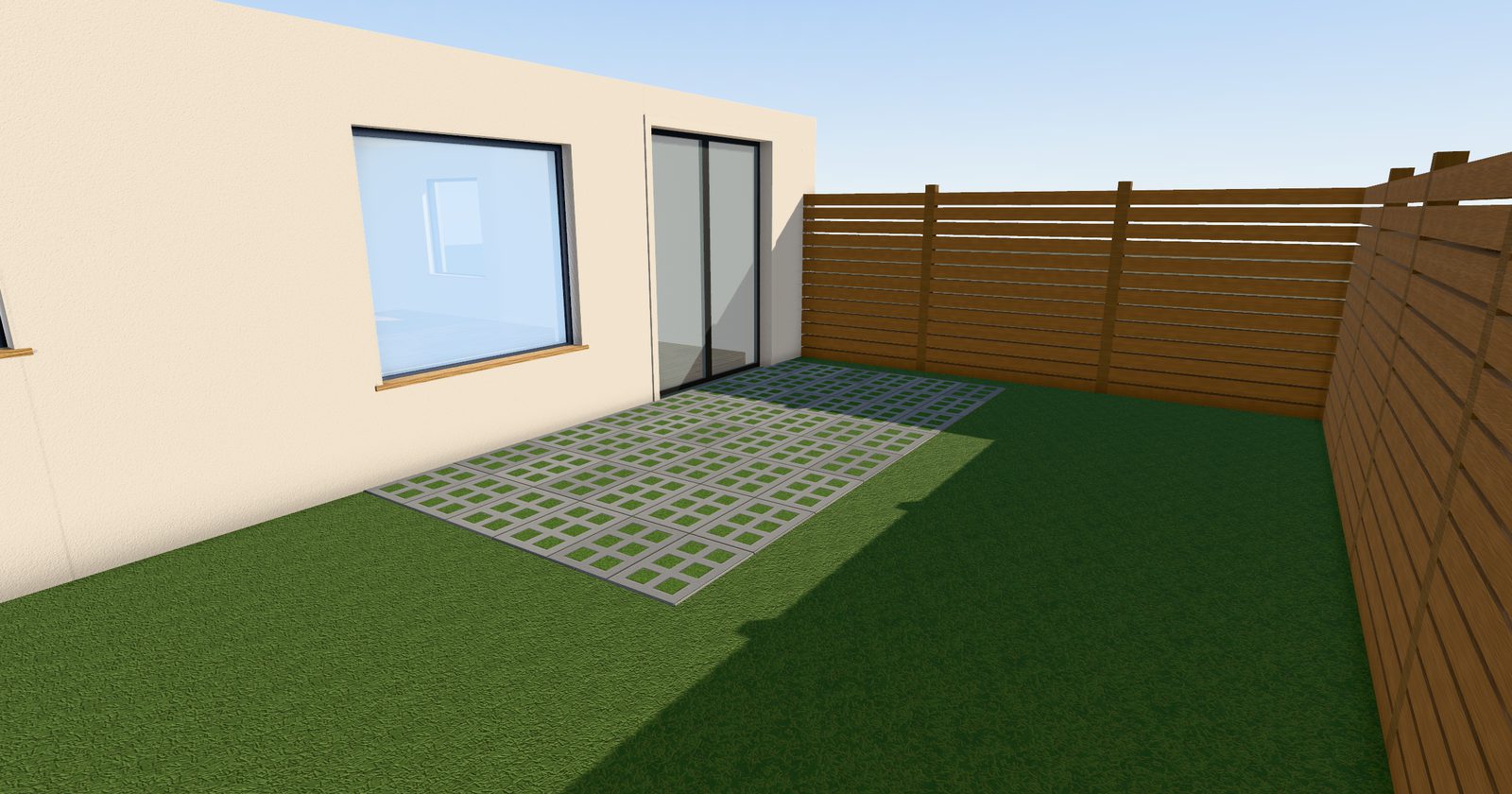
How many grass pavers for one parking space?
A pallet of grass pavers and a long afternoon at the saw
A grass paver is a slab that is mostly holes. That is the point of it: a car can stand on the concrete grid while grass grows through it and rain soaks away. It is also why cutting one is a chore. A strip of grid 20 cm wide is a ladder of thin webs, and it is the piece that cracks when the saw is through, or later under a tyre.
So the count matters twice: how many pavers to order, and how many of them go through the saw. The usual sum only answers the first. Here is one parking space laid three ways, counted paver by paver with Plan tiles in Duimstok, in its Grass Pavers: concrete, 60 × 40 cm, six holes each.
5.00 × 2.50 m: 53 by area, 63 pieces on site
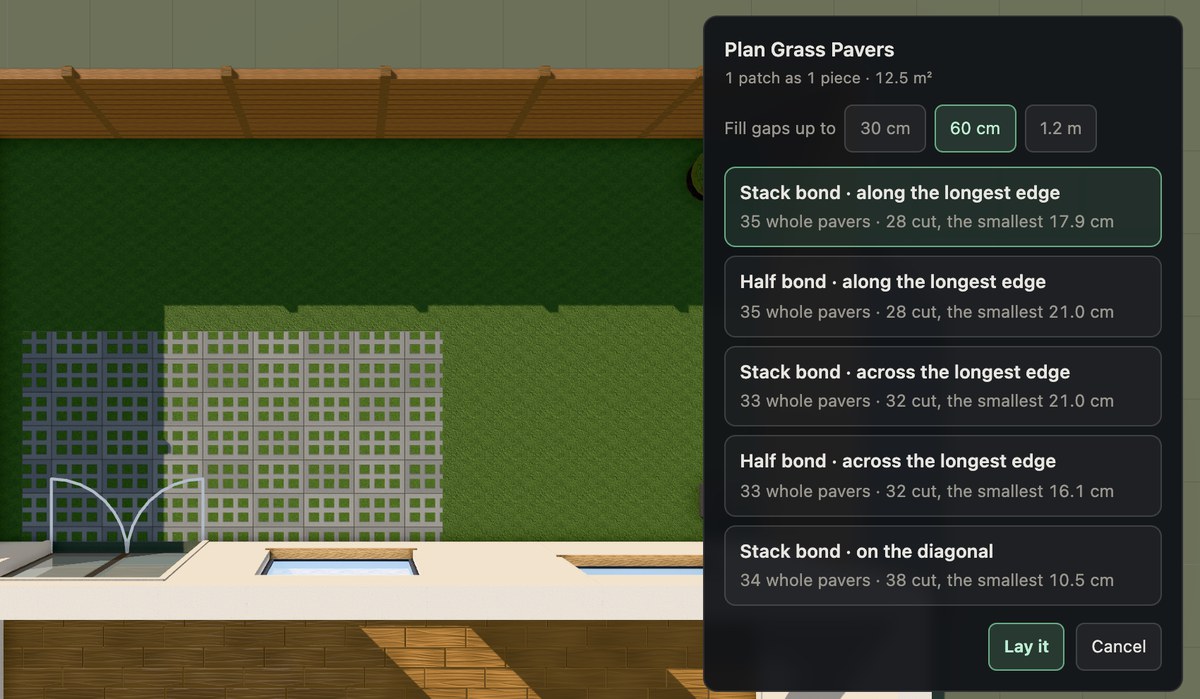
2.50 × 5.00 m is the size most people mean by "one parking space". It is 12.5 m², and one 60 × 40 cm paver covers 0.24 m², so the sum says 52.1: order 53.
Draw the space, select it and press Plan tiles. Stack bond along the longest edge: 35 whole pavers and 28 cut, the smallest 17.9 cm. Neither side of the space is a whole number of pavers in either direction, so the planner centres the grid and both ends and both sides get a cut row. That is 63 pieces in the ground, 28 of them through the saw.
Turning the pavers does not help. Across the longest edge it is 33 whole and 32 cut, the smallest 21.0 cm. Half bond gives the same 35 and 28 along, 33 and 32 across. On the diagonal it is 34 whole and 38 cut, the smallest 10.5 cm.
4.80 × 2.40 m: 48 whole pavers, none cut
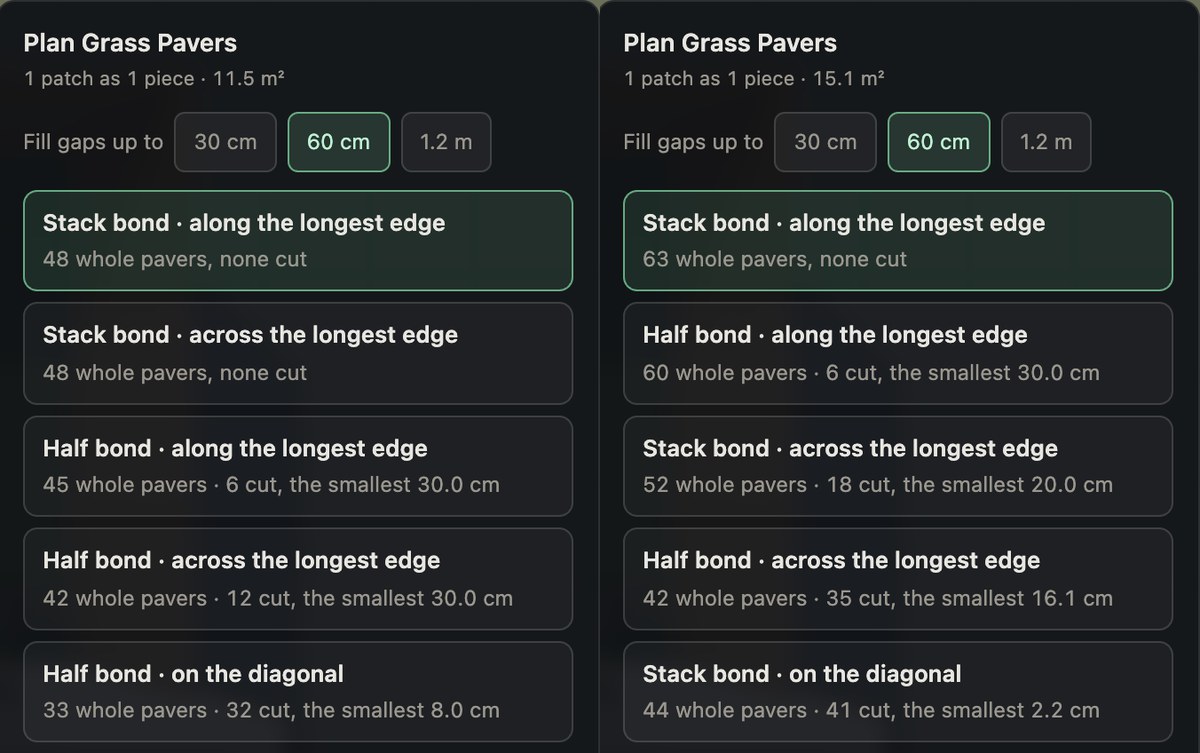
Now take 20 cm off the length and 10 cm off the width: 4.80 × 2.40 m, 11.5 m². Plan tiles says 48 whole pavers, none cut, and the same 48 with the pavers turned. The reason is plain once it is on the screen: 4.80 m is eight pavers of 60 cm or twelve of 40 cm, and 2.40 m is four of 60 or six of 40. Every row ends on a joint.
Even half bond stays tidy here: 45 whole and 6 cut along the longest edge, the smallest 30.0 cm, which are halves, three pavers' worth. Only the diagonal is messy again, 33 whole and 32 cut, the smallest 8.0 cm.
5.40 × 2.80 m: room for the doors, still no cuts
2.40 m is a narrow space when the driver opens the door onto a fence or a wall. Widening it by 40 cm costs nothing at the saw, as long as the length goes with it. At 5.40 × 2.80 m, 15.1 m², stack bond along the longest edge is 63 whole pavers, none cut: nine pavers of 60 cm along 5.40 m, seven of 40 cm across 2.80 m.
Here the direction matters. Turned across the longest edge, the same space is 52 whole and 18 cut, the smallest 20.0 cm, because 5.40 m is not a whole number of 40 cm pavers. Half bond along is 60 whole and 6 halves; half bond across 42 whole and 35 cut; the diagonal 44 whole and 41 cut, down to a 2.2 cm sliver nobody can lay.
The rule behind it: multiples of 40 and 60
With a 60 × 40 cm paver, a space lays without a cut when one side is a multiple of 60 cm and the other a multiple of 40 cm, with the pavers turned to match. For a parking space that gives a short list worth keeping by the phone:
- Widths: 2.40 m (4 × 60 or 6 × 40), 2.80 m (7 × 40), 3.00 m (5 × 60).
- Lengths: 4.80 m (8 × 60 or 12 × 40), 5.20 m (13 × 40), 5.40 m (9 × 60), 6.00 m (10 × 60 or 15 × 40).
2.50 m is on neither list, and that one number is where most of the 28 cuts in the first space come from. Where the client says "a parking space" and the plot allows it, drawing 2.40 or 2.80 instead of 2.50 is a line moved on the plan, not a change to the job.
Where the space is fixed, between a wall and a path for example, count before you quote. Twenty-eight cuts are twenty-eight trips to the saw, the odd paver broken in the cutting, and a row of narrow pieces at the edge where the restraint has to hold them. Quantities gives the area for the sub-base and the edging; Plan tiles gives the pavers you will actually lay.
Try it
- Press Top, open Catalog, search for grass and choose Grass Pavers.
- Draw the space where the car will stand, or type its size on the bar, for example 500 × 250.
- Click the space and press Plan tiles: each layout lists its whole and cut pavers and the smallest cut.
- Change the size to 480 × 240, or 540 × 280, and press Plan tiles again.
- Press Lay it on the layout you choose, then Walk round it with the client.
Questions people ask
How many grass pavers per square metre?
With 60 x 40 cm pavers, 4.17 by area: one paver covers 0.24 m². On a real space the count depends on how many pavers are cut at the edges.
How many grass pavers do I need for a parking space?
A 5.00 x 2.50 m space is 53 by area, but 35 whole pavers and 28 cut when laid. A 4.80 x 2.40 m space takes 48 whole pavers with none cut.
What size should a grass paver parking space be?
2.50 x 5.00 m is the size most often used for one car. With 60 x 40 cm pavers, 2.40 or 2.80 m wide and 4.80, 5.20 or 5.40 m long lay without cuts.