
Decking or paving round a pool? Count the joints
Three summers of weeding
Round the pool lie hundreds of small red pavers, and a weed grows in every joint. You have pulled them for three summers. Now the surround is going to be redone, and the choice is the one somebody asked a garden forum this autumn: something close to poured concrete, with as few joints as possible, or composite decking with a small stone apron at the water.
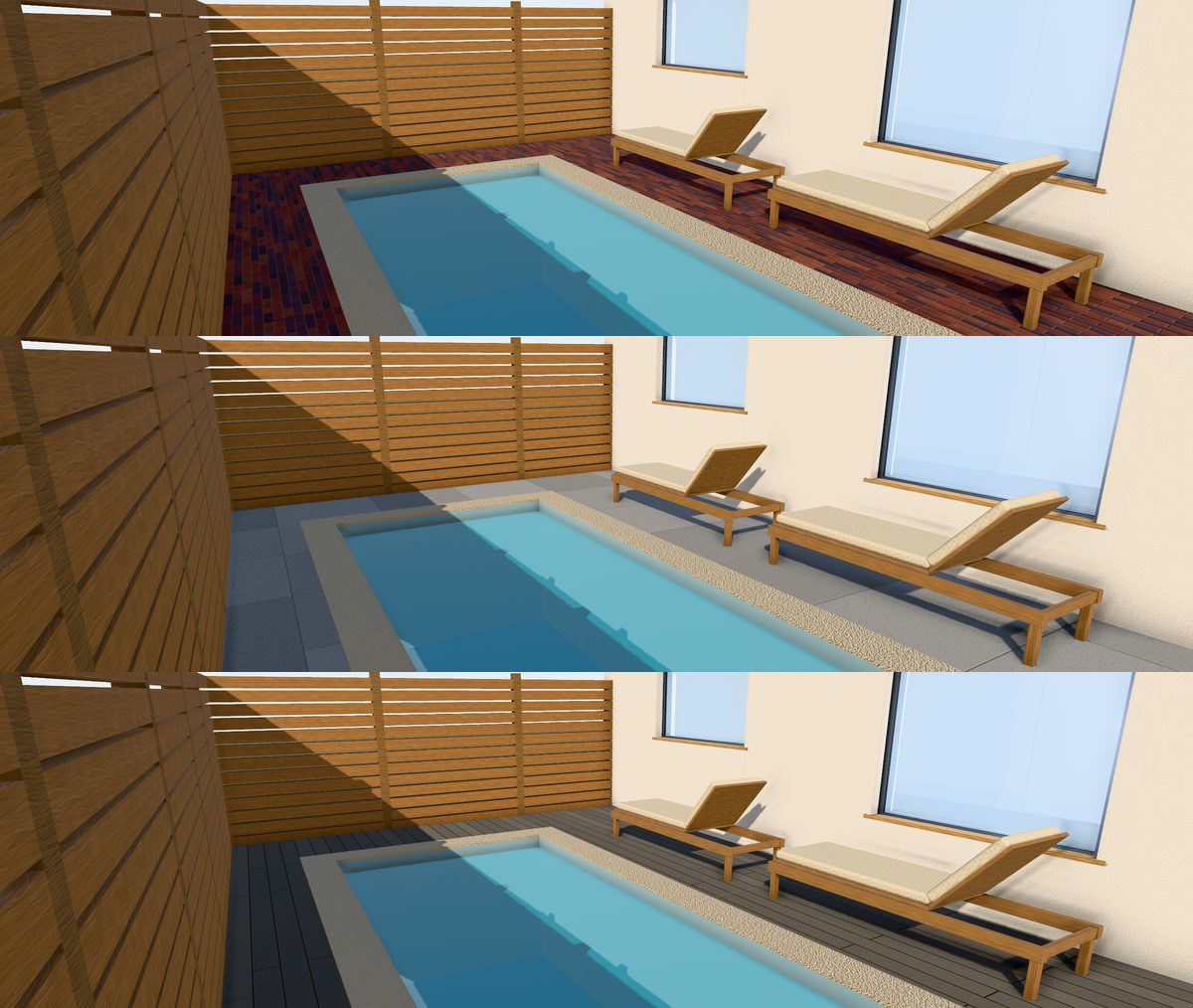
It is hard to choose from two samples on a table. So here is one pool surround laid three ways in Duimstok, with the number that matters for weeds: how many pieces, and so how many joints.
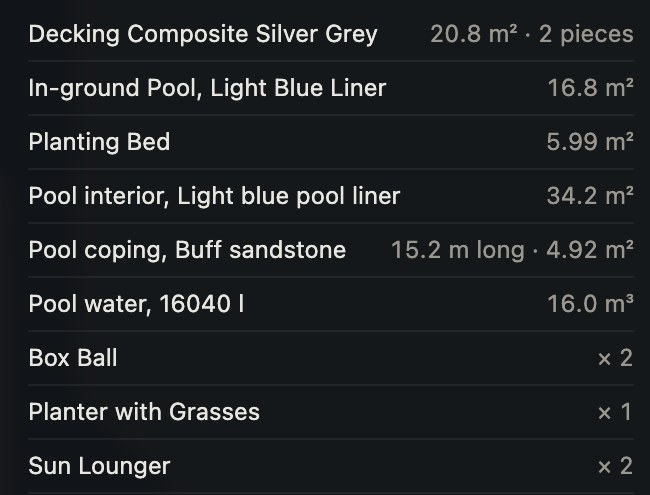
The pool and its surround: 20.8 m²
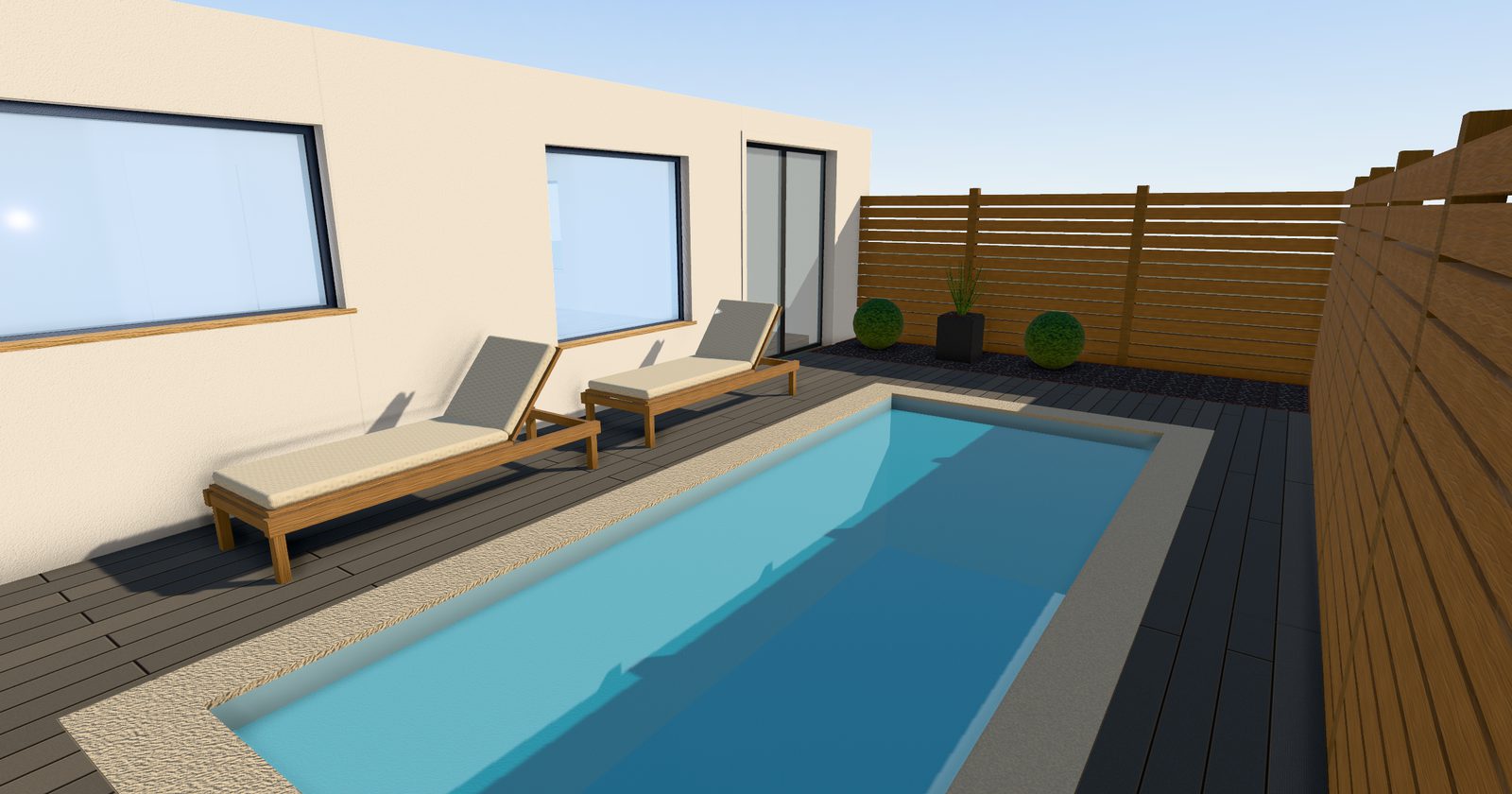
The garden is the 9.10 × 4.80 m back garden we use for every example. The pool is 6.00 × 2.80 m with its stone coping, the apron at the water: 30 cm wide and 15.2 m round. The water inside it is 5.40 × 2.20 m. A planting strip runs down one side of the garden.
Everything else is surround: 20.8 m². It is 1.4 m wide on the house side, where two sun loungers stand, about 1 m and 85 cm at the ends, and 60 cm along the back fence.
Small pavers: 2,088 of them
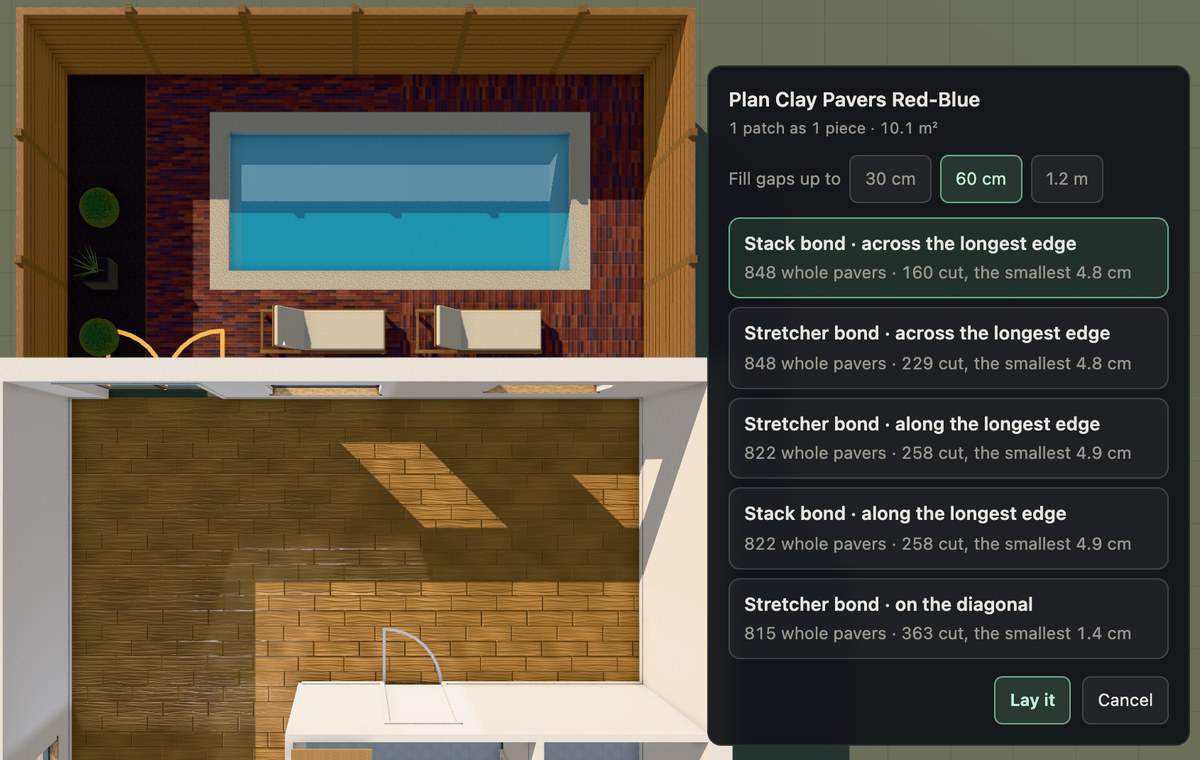
First the surround as it is now, in red-blue clay pavers of 20 × 5 cm. Duimstok's Plan tiles lays them out and counts them. In the bond with the fewest cuts that is 1,798 whole pavers and 290 cut, 2,088 in all. That is 100 to the square metre, and every one has a sand joint on all four sides.
Small pavers follow a pool's narrow margins well, and the cuts are small. The joints are the price. For other sizes see how many pavers per square metre.
Large slabs: 28, and 25 of them cut
Duimstok has no poured concrete, so the nearest look is a grey concrete tile of 100 × 100 cm. The same surround takes 28 tiles. The joints fall from thousands to a few dozen.
But look at the count: 3 whole tiles and 25 cut. The margins are 60 cm to 1.4 m wide, so a metre-wide slab almost never fits whole. Every cut is a pass with a saw and a strip of waste. A smaller slab may waste less; lay it and read the count before you order.
Composite decking: no sand joints
Third, grey composite boards over the same 20.8 m². There is no sand joint for a seed to root in, and the boards run past the pool in long, calm lines.
Two things to check with a sample before you decide: stand on it barefoot after it has been in the sun, and ask the supplier how it grips when wet.
The apron stays the same
In all three versions the pool keeps its own stone coping, the "small apron" at the water's edge. It is part of the pool, not of the surround, and the Quantities list counts it apart: 15.2 m long, 4.92 m². So you can change the surround as often as you like and the pool's own numbers stay put.
Side by side
- Clay pavers 20 × 5 cm: 2,088 pieces, 290 of them cut, a joint round every one.
- Concrete tiles 100 × 100 cm: 28 pieces, 25 of them cut.
- Composite decking: 20.8 m² of boards, no sand joints.
Try it
- Open your plan, press O for the view from above and open Catalog.
- Search for pool, pick an In-ground Pool and lay it; type its size on the bar.
- Pick a covering, for example Clay Pavers Red-Blue, press Fill and click the ground beside the pool.
- Click the surround to read its m² on the bar, and press Plan tiles for the whole and cut pieces.
- Press Select all like this and pick another covering in the catalog to lay the surround in that instead.
- Press Walk and look at it from the garden doors.
Limits worth knowing
- Fill laid this surround as two pieces. Plan tiles counts one piece at a time, so add the two counts.
- There is no poured concrete in the catalog; a large concrete tile is the nearest look.
- Decking is shown lying on the ground, 3 cm thick. The frame under a real deck, and the step up it makes, are not drawn.
- The app counts pieces and square metres. It does not rate a surface for grip or heat.
Questions people ask
How wide should the surround of a pool be?
Enough to walk past, about 60 to 90 cm, and more where people lie. A sun lounger is about 2 m long, so a 1.4 m strip takes loungers lengthways along the pool, as here.
How do I stop weeds between pavers round a pool?
Fewer joints give fewer weeds. A 20 × 5 cm paver means 100 pieces per square metre; a 100 × 100 cm slab means one. Decking has no sand joints at all.
How many pavers do I need round a pool?
Measure the surround without the pool and its coping. This one is 20.8 m², which took 2,088 pavers of 20 × 5 cm.