
How many pavers per m²? Count the cuts as well
The pallet that runs out on the last row
A terrace of clay pavers is priced from its m², times a number per m² from the supplier's sheet, plus a percentage for waste. Then the last row along the fence needs half pavers, every row of them, and the half that is cut off one paver is too short for the next row. The pallet runs out a metre from the end, and the waste percentage was a guess.
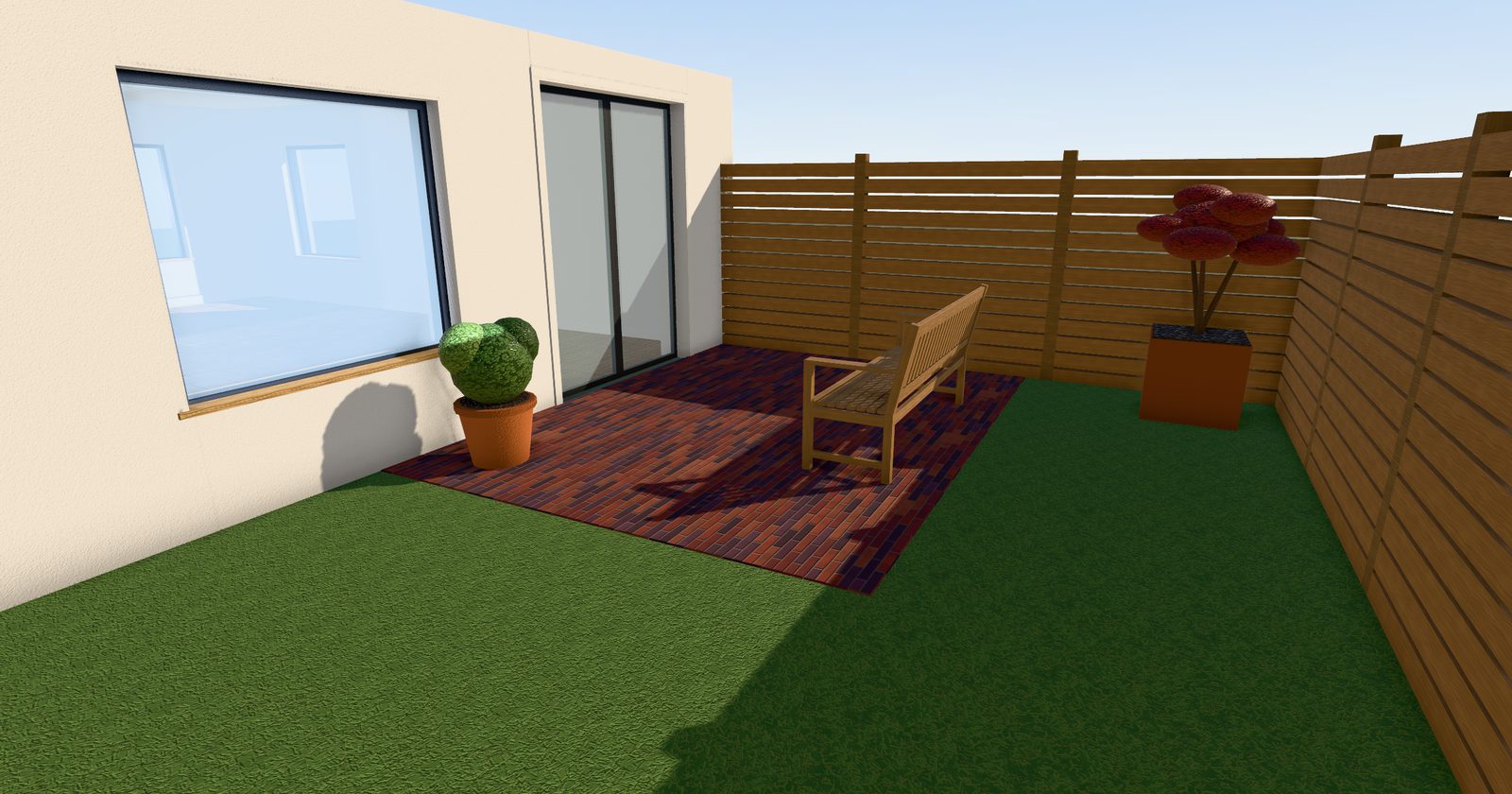
The count per m² is easy. The number of cuts depends on the bond and on how it meets the edges, and that is what this post works through, with a 12 m² terrace counted in Duimstok.
Per m²: one over the paver's face
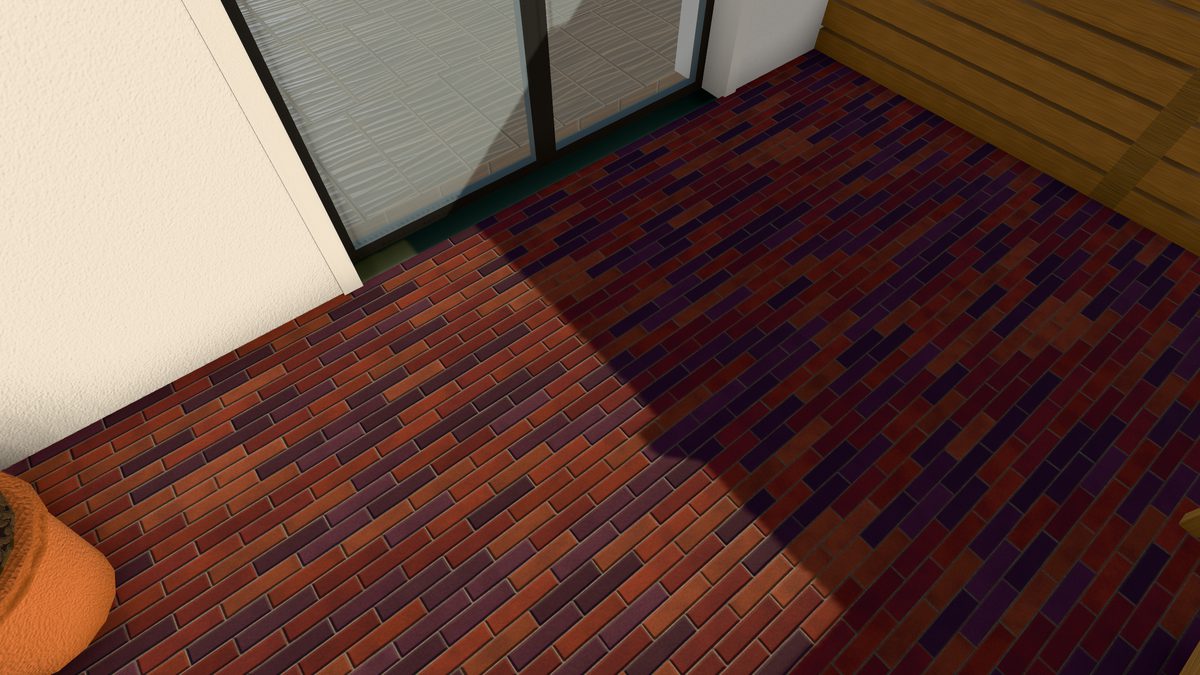
A clay paver in waal format laid on edge shows a face of 20 × 5 cm: 0.01 m². So:
- 20 × 5 cm: 1 ÷ 0.01 = 100 pavers per m², without joints.
- 20 × 10 cm (a paver laid flat): 50 per m².
- 21 × 7 cm (a thick format on edge): about 68 per m².
Joints of 2 to 3 mm bring the real number down a little; the supplier's sheet gives it for each paver with its joint. The terrace here, 4.00 × 3.00 m against the house, is 12.0 m²: 1,200 pavers at 100 per m².
The bond decides the cuts
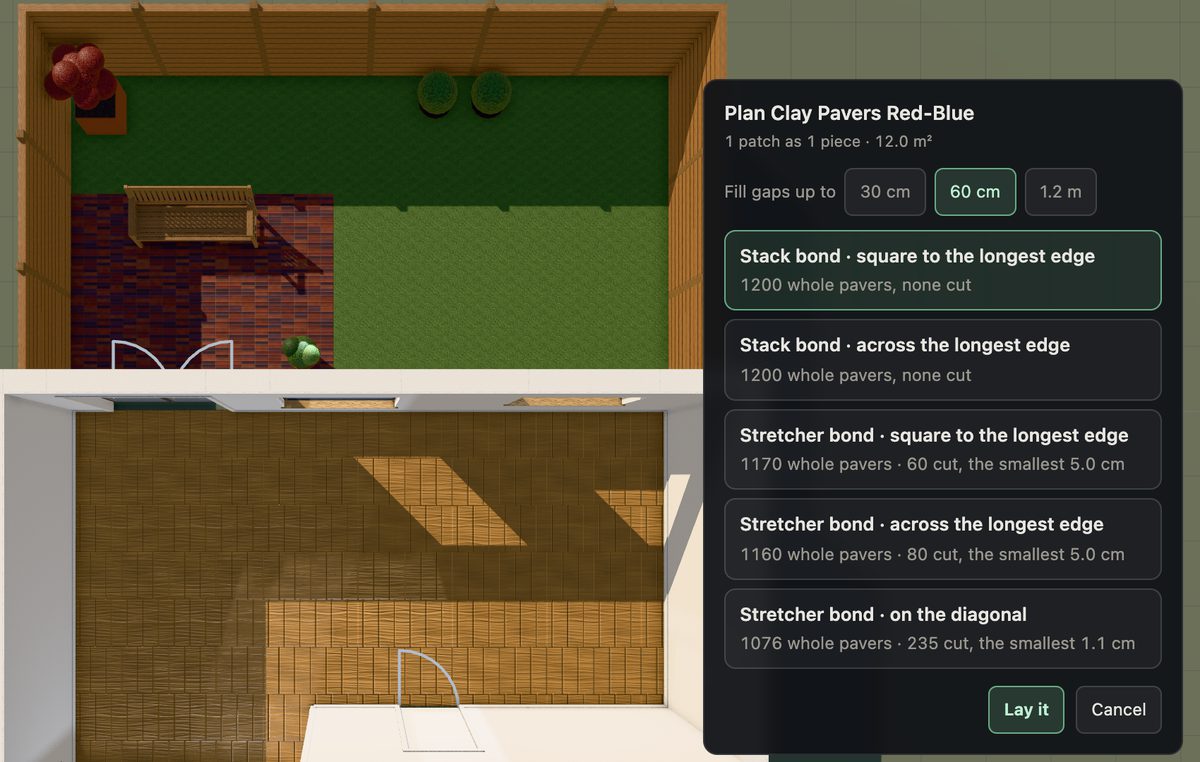
The same 1,200 pavers' worth of terrace, laid five ways, as the tile planner counts them:
- Stack bond, either way round: 1,200 whole, none cut. 4.00 m is twenty pavers long and 3.00 m sixty wide, exactly.
- Stretcher bond, square to the longest edge: 1,170 whole and 60 cut, the smallest 5.0 cm. Every second row starts with a half.
- Stretcher bond, across the longest edge: 1,160 whole and 80 cut.
- Stretcher bond on the diagonal: 1,076 whole and 235 cut, the smallest 1.1 cm.
So the diagonal costs about four times the cuts of a straight stretcher bond on the same terrace, and leaves slivers of a centimetre at the edges. That is labour on the quote and pavers on the order, and now you can put a number on both.
Size the terrace to the paver
The cheapest cut is the one you design out. A terrace whose sides are whole multiples of the paver lays in stack bond with no cuts at all, and in stretcher bond with a half at every second row end and nothing else. Change 4.00 m to 4.07 m and every row ends in a sliver. When the client has no reason for an exact size, give them the one the paver wants.
Try it
- Press Top, open Catalog, search for pavers and choose one, for example Clay Pavers Red-Blue.
- Draw the terrace, or type its size on the bar.
- Click the terrace and press Plan tiles: each layout shows its whole and cut pavers and the smallest cut.
- Pick a layout and press Lay it; the terrace is laid that way.
- Press Walk and look at the bond from the door.
Limits worth knowing
- The counts assume no joint width; take the supplier's figure per m² for the order.
- The tile planner offers stack and stretcher bond; it has no herringbone yet.
Questions people ask
How many clay pavers are there in a m²?
About 100 in waal format laid on edge (20 × 5 cm), and about 50 laid flat (20 × 10 cm), a little fewer with joints.
Which bond has the least waste?
Stack bond, then stretcher bond square to an edge. A diagonal cuts every paver along every edge.
How much extra should I order for cuts?
Count the cut pavers for the layout you choose; each one is a whole paver bought. Add a few for breakage.