
Steel, kerb or sleeper edging round a curved bed?
The curve that was drawn with a garden hose
The client laid a garden hose on the lawn to show the bed they wanted: an oval, soft at the ends, nothing straight about it. On paper it is one line. On site it is an edging that has to follow that line for its whole length, and what it costs depends far more on the edging than on the length.
A homeowner asked on Houzz last month which material makes a good, thick mowing edge round a tree and along a walkway. For a curve the honest answer is a count. Here it is for one oval island bed, edged three ways in Duimstok, before anything is ordered.
The bed: an oval 4.0 by 3.0 metres, 15 cm up
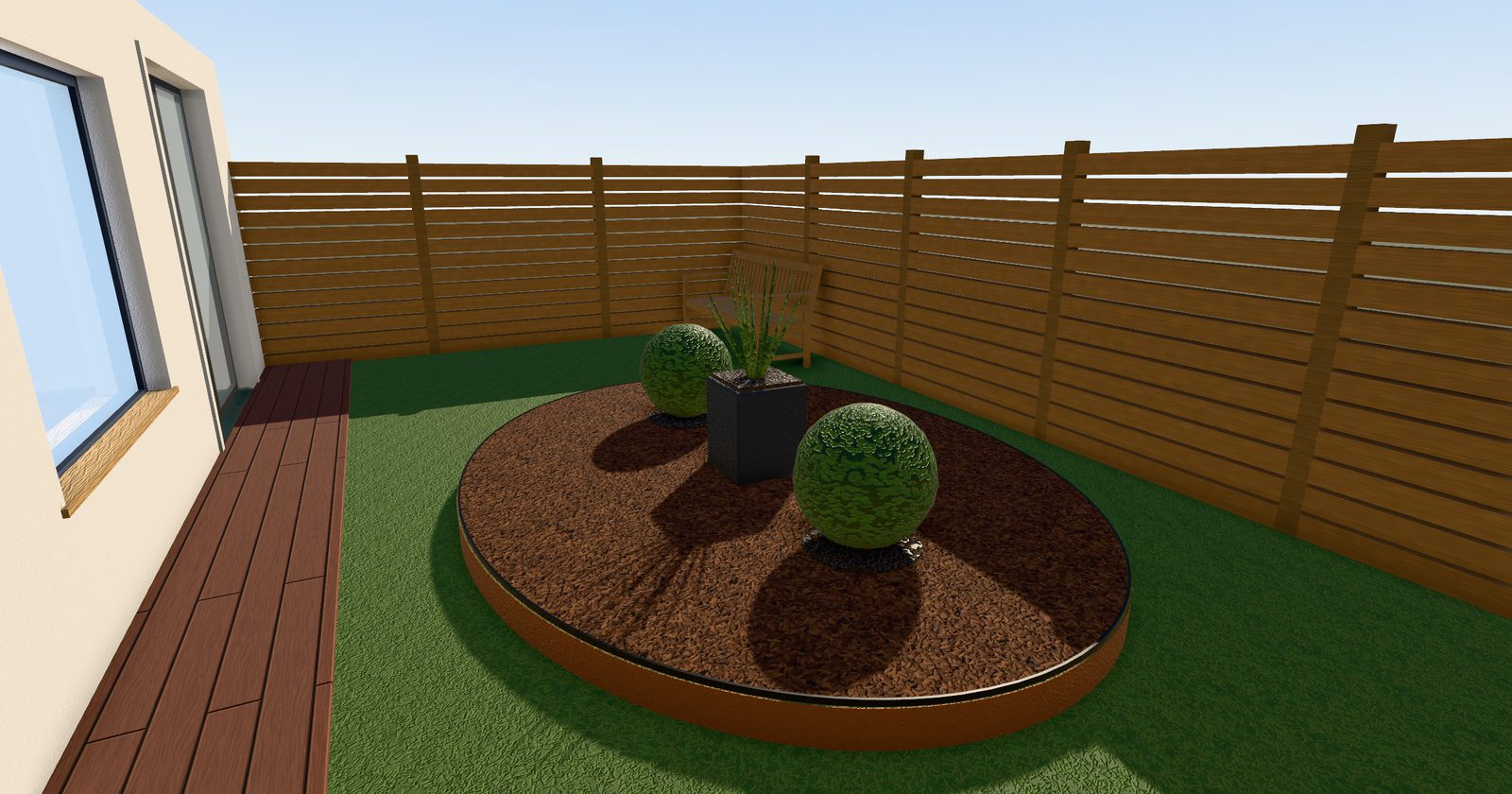
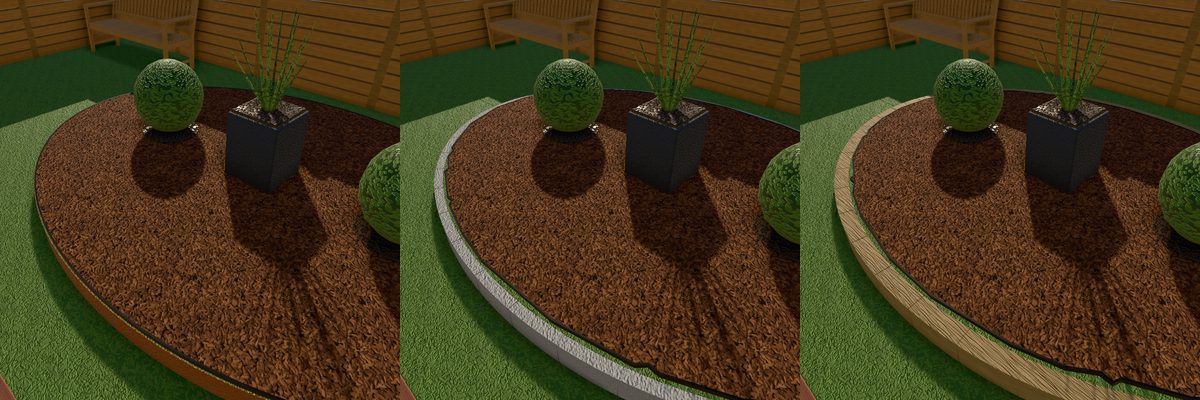
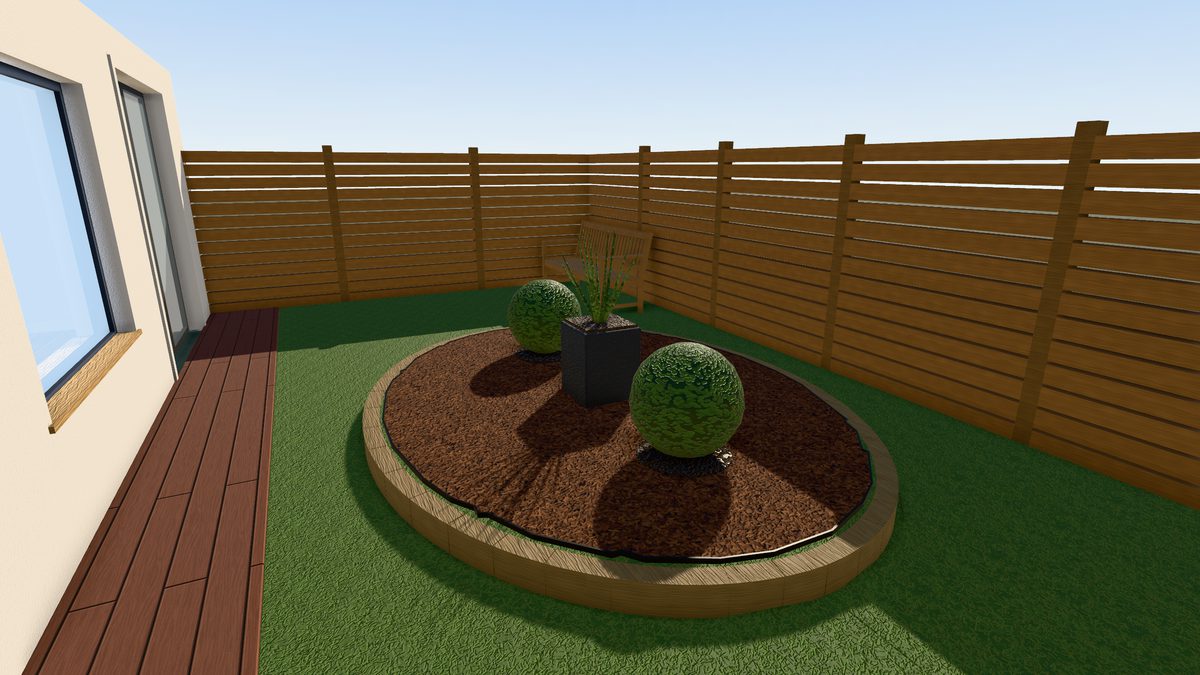
The bed is drawn with the Level tool as a curve through sixteen points: an oval 4.0 m long and 3.0 m wide in the middle of the lawn, raised 15 cm, with bark mulch on top, two box balls and a planter. Round it goes 11.05 m of edge. Its tightest curve, at the two ends, has a radius of about 1.1 m; along the sides it is about 2.7 m. A level takes a wall type for its sides, and three of them suit an edge this low:
- Steel edging, a strip 2 to 3 mm thick sold in 2.30 m lengths. Here in weathering steel.
- Concrete kerb, 1.00 m long, 20 cm high and 6 cm thick, set on edge.
- Timber sleeper, 2.40 m long, 20 cm high and 10 cm thick. Here in oak.
Steel and kerb are made for one step: Duimstok lets either hold up to 17 cm, and the 15 cm here is within that. Steel also bends by hand to about a 1 m radius, so this oval is about as tight as it goes without pre-bending; draw a tighter curve and Duimstok warns you.
What Quantities counts
Open the catalog's Quantities list and each edging gets a row of its own. The length is the same 11.05 m all three times (the list rounds it to 11.0). The rest is not.
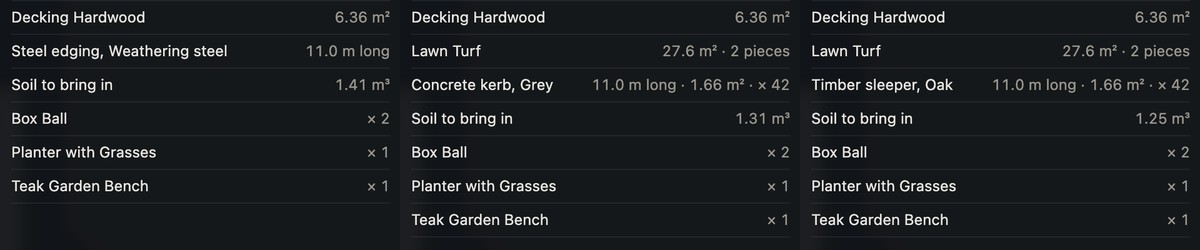
Steel: 11.05 m, no pieces. Steel bends, so Duimstok lays it as one band round the curve and counts it by the metre. At 2.30 m a strip, 11.05 m is 4.8 strips: order five, and the last is cut 45 cm short.
Kerbs: 42 pieces. A kerb does not bend. Duimstok lays rigid units along a curve the way a paver does on site, and cuts a unit where it would stand more than 5 mm off the line. Along the sides, where the radius is about 2.7 m, a whole 1 m kerb would stand about 5 cm off the curve at its middle, so the pieces come out around 33 cm. At the ends, radius 1.1 m, they are about 21 cm. 42 pieces for 11.05 m is about 26 cm each. Quantities counts pieces laid, not kerbs bought: three or four pieces come out of each 1 m kerb, so order eleven to fourteen, and expect nearly every piece to have a cut end.
Sleepers: also 42. A 2.40 m sleeper is longer than a kerb, which helps not at all. The curve decides how long a straight piece may be, not the unit, so the sleepers are cut at the same places into the same 42 pieces.
Two more numbers on the list follow from the edge. The kerb's 1.66 m² is its face, 11.05 m times 15 cm, for when you price an edge by area. And the soil to bring in for the bed drops from 1.41 m³ with steel to 1.31 with kerbs and 1.25 with sleepers: a thicker edge takes more of the bed's volume.
The same bed with straight sides
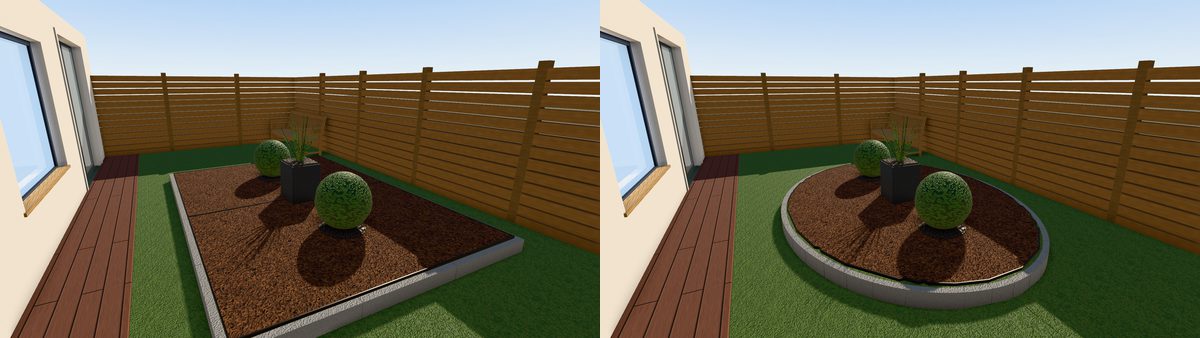
Draw the bed as a rectangle of 4.0 by 3.0 m instead, and kerb it. The edge is longer, 14.00 m against 11.05, and yet Quantities says × 14: fourteen whole kerbs, not one cut. That is the trade-off in one comparison. A curve in concrete or timber is short pieces and cuts. A curve in steel is a few strips and one cut. Straight lines suit the units that come in lengths.
Which to quote
For a curve like this oval, steel is the edging that was made for it: a thin line that follows the hose, cut once. Kerbs give the thick, hard mowing edge people ask for, and they are the right choice on straight runs and gentle curves; on tight ones, put the cuts in the price. Sleepers read as a timber frame, and on a curve they become a row of short blocks, which some clients like and many do not expect. Show them first.
Try it
- Open your garden plan and press O for the view from above.
- Press Level, then Shape, and click the points of the bed; type its height, 15, on the bar.
- Pick the bed's wall on the bar: T runs through the types until you reach Steel edging, Concrete kerb or Timber sleeper.
- Open Catalog and the Quantities list. Read the edging row; change the wall and read it again.
- Cover the bed and the lawn. In version 1.0.11 Fill finds no free ground in a garden that has a steel-edged level, so draw the coverings with Curve or Rectangle there.
- Press Walk and look at the edge from the terrace, where the client will.
Questions people ask
How much lawn edging do I need for a curved bed?
Measure the edge, not the bed: an oval 4 by 3 m is 11.05 m round. In steel that is five strips of 2.30 m. In rigid kerbs or sleepers count the pieces as well, because a curve cuts them short: 42 pieces on this oval.
Can you lay concrete kerbs on a curve?
Yes, in short pieces. A 1 m kerb strays about 5 cm from a curve of 2.7 m radius, so it is cut to around 33 cm there, and to about 21 cm where the radius is 1.1 m. On curves steel edging is usually the simpler choice.
How tight a curve can steel edging follow?
A strip 2 to 3 mm thick bends by hand to about a 1 m radius. Tighter than that it has to be bent before it goes in, so check the tightest point of the curve first.