
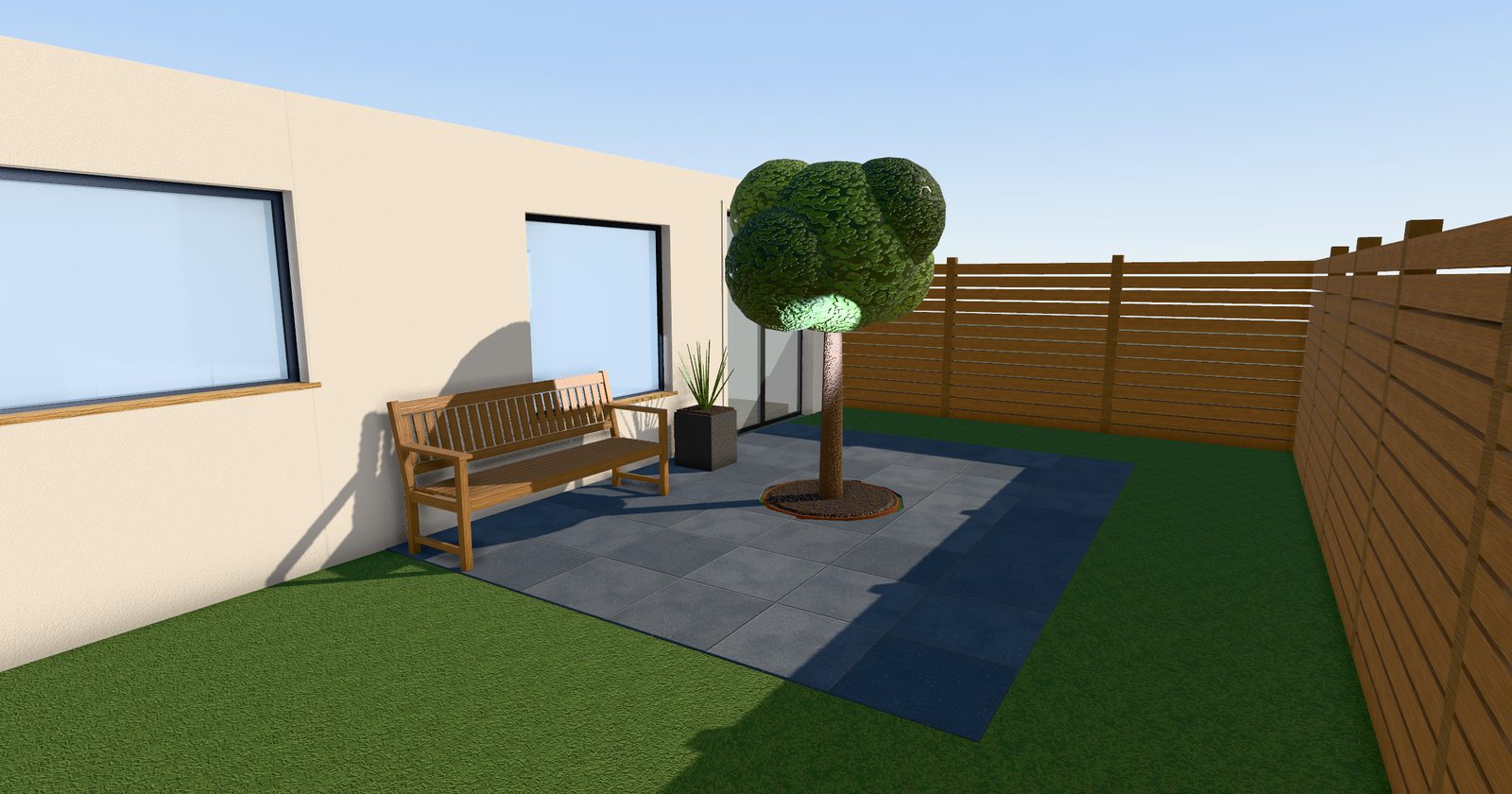
Paving round a tree: count the cuts before you order
Day two, and the saw comes out
The terrace went down fast. Sixty by sixty, straight joints, eight slabs across and six deep, and not one cut on the first day. Then the rows reach the tree. The client wants it kept, in a round bed in the middle of the paving, and every slab that touches that circle now goes to the saw for a curve. You counted on four. By the afternoon it is eight, one of them has snapped at its thin end, and the pallet has no spare.
The tree did not move overnight. The joints could have. Where a round bed sits against the joints decides how many slabs you cut, and you can know the number before the pallet is ordered. Here it is worked out on one terrace in Duimstok.
The terrace without the tree: 48 slabs, no cuts
The example is a terrace of 4.8 × 3.6 m against the house, in Bluestone 60×60. That is 17.28 m², and in stack bond it is eight slabs by six: 48 slabs. Select it from above, press Plan tiles, and the first layout reads 48 whole slabs, none cut. This is the job you priced in your head.
Now put a round bed in it for the tree, one metre across. The bed takes 0.78 m² out of the paving, about two slabs' worth. What it does to the cutting depends on where its centre is.
Draw it the way you set it out
Nobody draws a terrace with a round hole in one go, and you do not have to. Draw the bed first: Planting Bed, Curve, a ring of points round the trunk. Then lay the paving the way you would string it out on site, as four plain strips round the bed, leaving a square opening a little bigger than the circle.
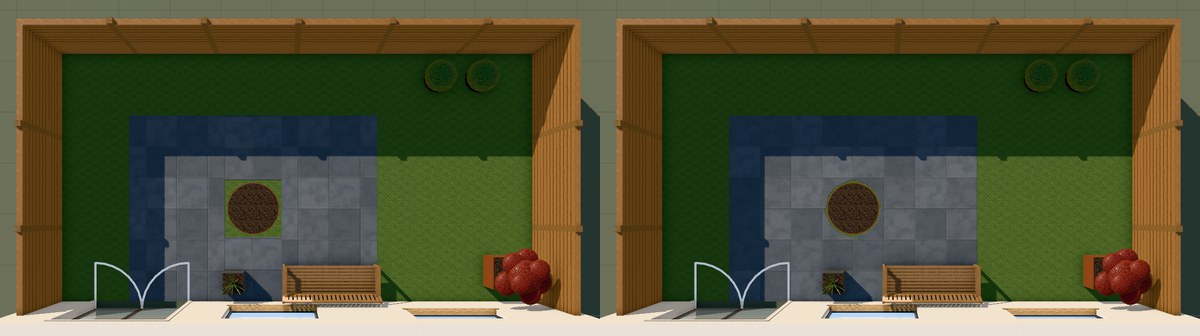
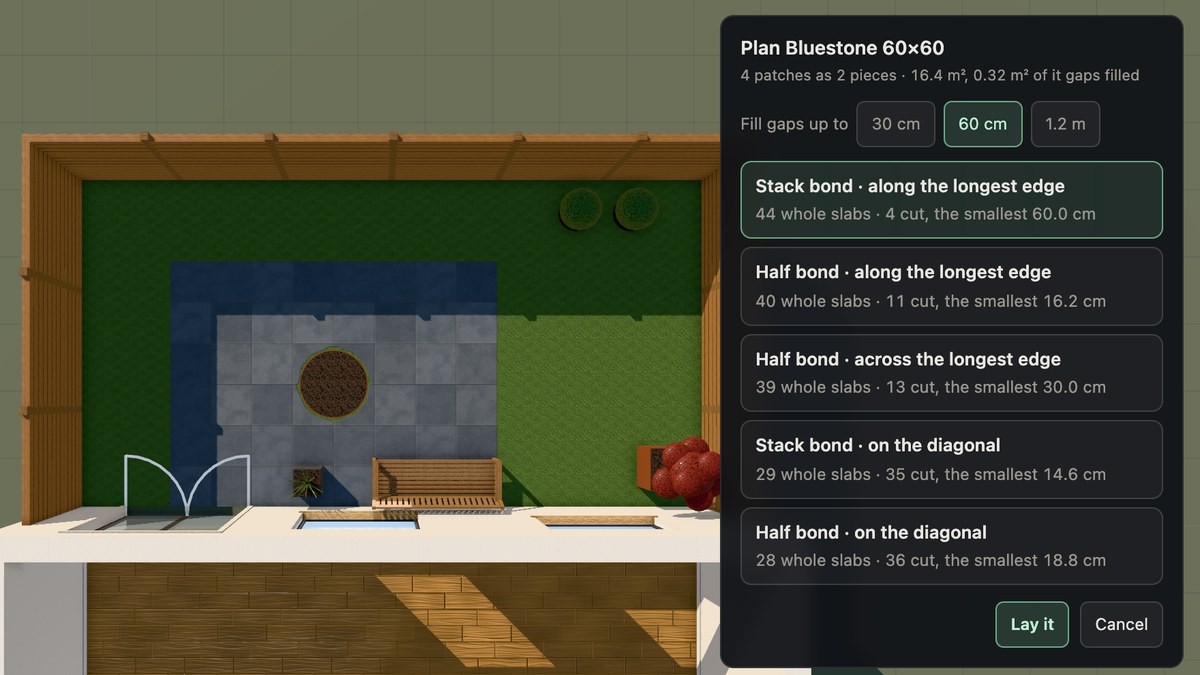
Click one strip, press Select all like this, then Plan tiles. The planner merges the four strips and fills the gaps they leave, and since version 1.0.11 that includes the four corners between your square opening and the round bed: the bed itself closes them. The panel says so in one line: 4 patches as 2 pieces · 16.4 m², 0.32 m² of it gaps filled. Two pieces, because a ring is laid as two halves that meet on a line through the bed; the joints run straight through and each slab is counted once. The area is 16.4 m² and not 16.5 because the planner keeps the paving a few centimetres off the bed's edge.
Where the bed sits and how wide it is: three counts
The same terrace, the same slabs, the same stack bond. Only the bed changes.
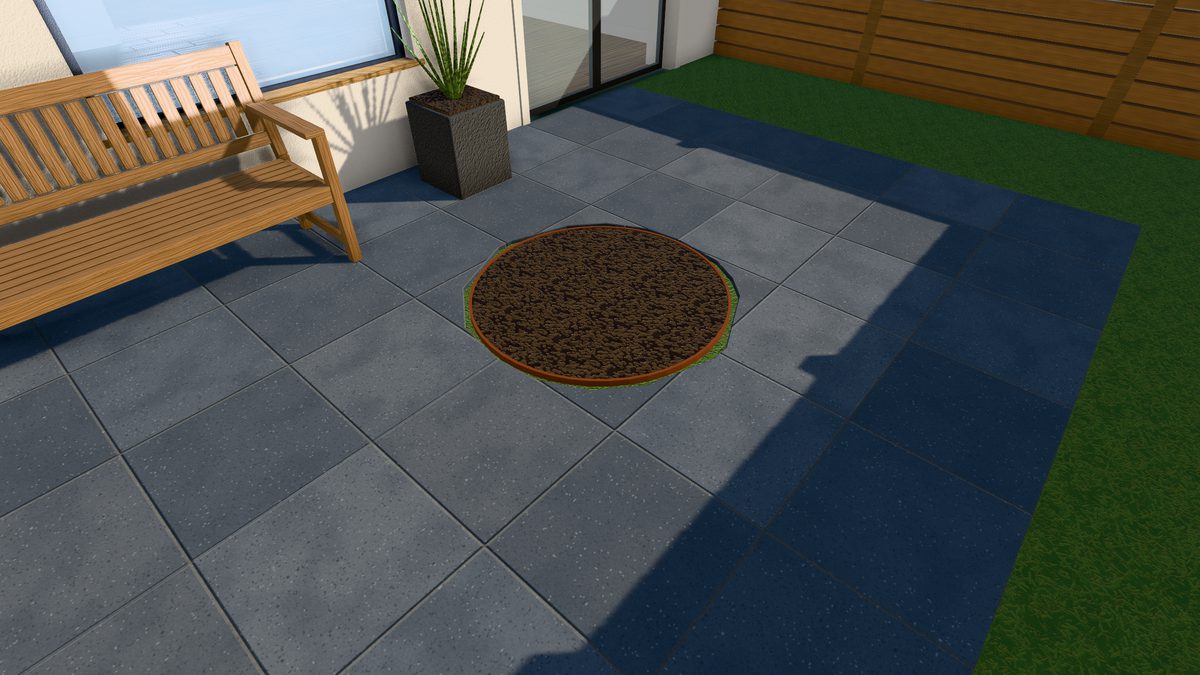
- A 1.0 m bed centred on a joint crossing: 44 whole, 4 cut. Four slabs meet at the trunk and each loses one rounded corner. The four cuts are the same, so one template does them all. You buy 48 slabs.
- The same bed centred on a slab, 30 cm over and 30 cm up: 39 whole, 8 cut. The slab under the tree is gone. Its four neighbours each lose a curved strip along one whole edge, 10 to 20 cm deep, and the four slabs on the diagonals each lose a corner tip 10 cm long. Two kinds of cut, eight in all. You buy 47 slabs and make twice the cuts.
- A 1.2 m bed, exactly two slabs wide, on a crossing: 36 whole, 12 cut. The circle's edge now lies on the joints of the next row out. The planner counts those eight slabs as cut as well, because the outline touches them: on site they are eight slabs with no margin at all against the bed's edging. The bed takes 1.13 m² and the paving drops to 16.0 m².
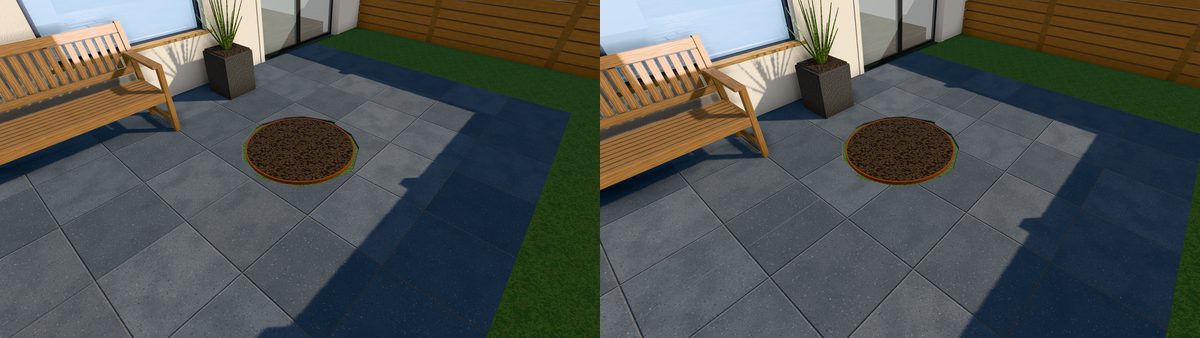
Thirty centimetres each way decide between four cuts and eight. And the bed that looks like the tidy choice, two slabs wide so it "fits the grid", is the worst of the three: a circle as wide as two slabs touches twelve of them. Ten centimetres smaller, and the next row is clearly out of it.
What to do with that on site
With a new tree you choose the spot, so plant it on a crossing and size the bed a little under two slabs. With a tree that is already there, the trunk is fixed and the joints are not. Measure from the house wall and the side fence to the trunk, draw the bed where it really is, and then try starting the slabs from the other edge, or with a cut row against the wall. A row of straight cuts along one edge is routine work. Curved cuts round a trunk are not.
The bond matters as much. In half bond the same bed on the same crossing is 40 whole slabs · 11 cut, the smallest 16.2 cm: every other row shifts 30 cm, so the bed cannot sit on a crossing in both. On the diagonal it is 29 whole and 35 cut. If the client wants a tree in the terrace and half bond, the quote should know that before they sign.
Order by the slab, not by the square metre
Quantities gives the paving as 16.4 m² once the bed is in. Divide by 0.36 m² a slab and you get about 45.5, so 46 slabs. Both one-metre layouts above need 47 or 48, because a cut slab is still a bought slab. On a small terrace the gap between the area sum and the real count is exactly the slab or two you are short on day two. Take the whole and cut counts from the planner, add your spares for the curved cuts on top, and put the m² on the Quote with your own price.
The planner counts what the outline crosses. It does not write a cutting list, and it draws the bed where you drew it, so the count is as good as your measurement of the trunk.
Then let the client stand next to it
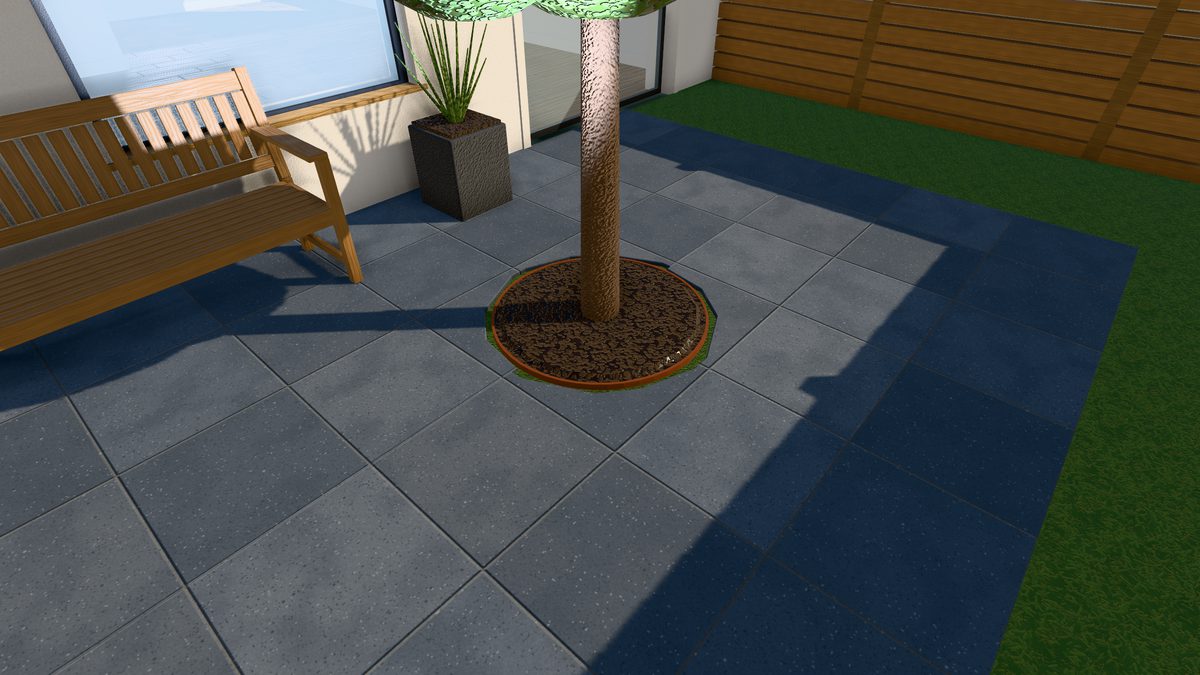
Press Lay it, set a Small Tree in the bed and press Walk. The client sees the tree in the terrace from the back door and from the lawn, with the joints where they will be. If they want the bed bigger, you change it while they watch, and the count changes with it.
Try it
- Open your plan and press O for the view from above. Open Catalog, pick Planting Bed, press Curve and click a ring of points where the tree stands.
- Search for bluestone, pick Bluestone 60×60 and drag out four strips round the bed.
- Click one strip and press Select all like this.
- Press Plan tiles and read the whole and cut slabs for each layout. Click a layout to see it in place.
- To compare, press Cancel, draw the bed 30 cm further along and 30 cm further out, lay the four strips round it again and plan again.
- Press Lay it on the layout you will build, then Walk.
Questions people ask
Is it better to centre a tree bed on a slab or on a joint?
On a joint crossing. A round bed one metre across in 60 × 60 cm slabs then cuts four slabs, one rounded corner each, all four the same. Centred on a slab it cuts eight, in two different shapes.
How many extra slabs do I need for paving round a tree?
Count slabs, not square metres. The bed takes area away but the slabs it crosses are still bought whole: a 4.8 × 3.6 m terrace with a one-metre bed is 16.4 m², which is 46 slabs by area and 47 or 48 on the ground. Your spares for curved cuts come on top of that.
Does the laying pattern change the number of cuts round a tree?
Yes, a lot. In the example, stack bond gives 4 cut slabs, half bond 11 and a diagonal bond 35. A bed can sit on a joint crossing in every row only when the joints line up in both directions.