
How many plants does a border need? Count from m²
Twenty short on planting day
The nursery's lorry is in the street, the soil is prepared, and halfway along the border the crew runs out of perennials. Twenty short. The quote said "border, supply and plant", and the number behind it came from pacing the bed out on the first visit: nine metres long, about a metre deep, nine square metres.
The bed was not nine square metres. Its front edge curves in and out, and at the deepest point it is one and a half metres from the fence. Planting is priced and ordered per square metre, so an error in the area goes straight into the plant count, the soil improver, the mulch and the hours.
Measure the bed as it is drawn
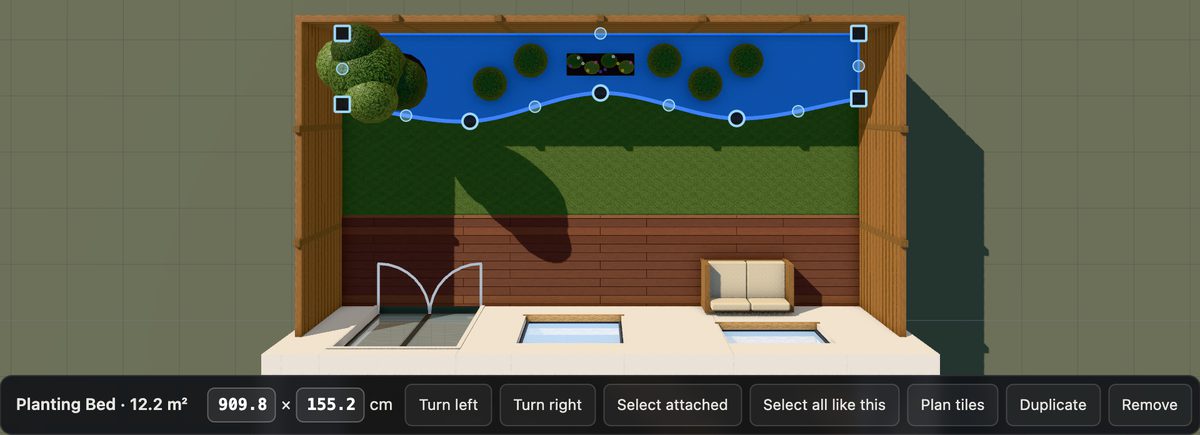
In Duimstok a planting bed is drawn from above, point by point, the way you would draw it on the plan: pick Planting Bed in the catalogue, choose Curve on the bar, and click the points the edge passes through, with Shift for a corner. The bar shows the square metres as you draw, and select the bed later and it shows them again.
The border in the pictures runs the 9.1 m width of the garden. It reads 12.2 m². The paced estimate was 3.2 m² short, more than a quarter of the bed.
Place the structure first
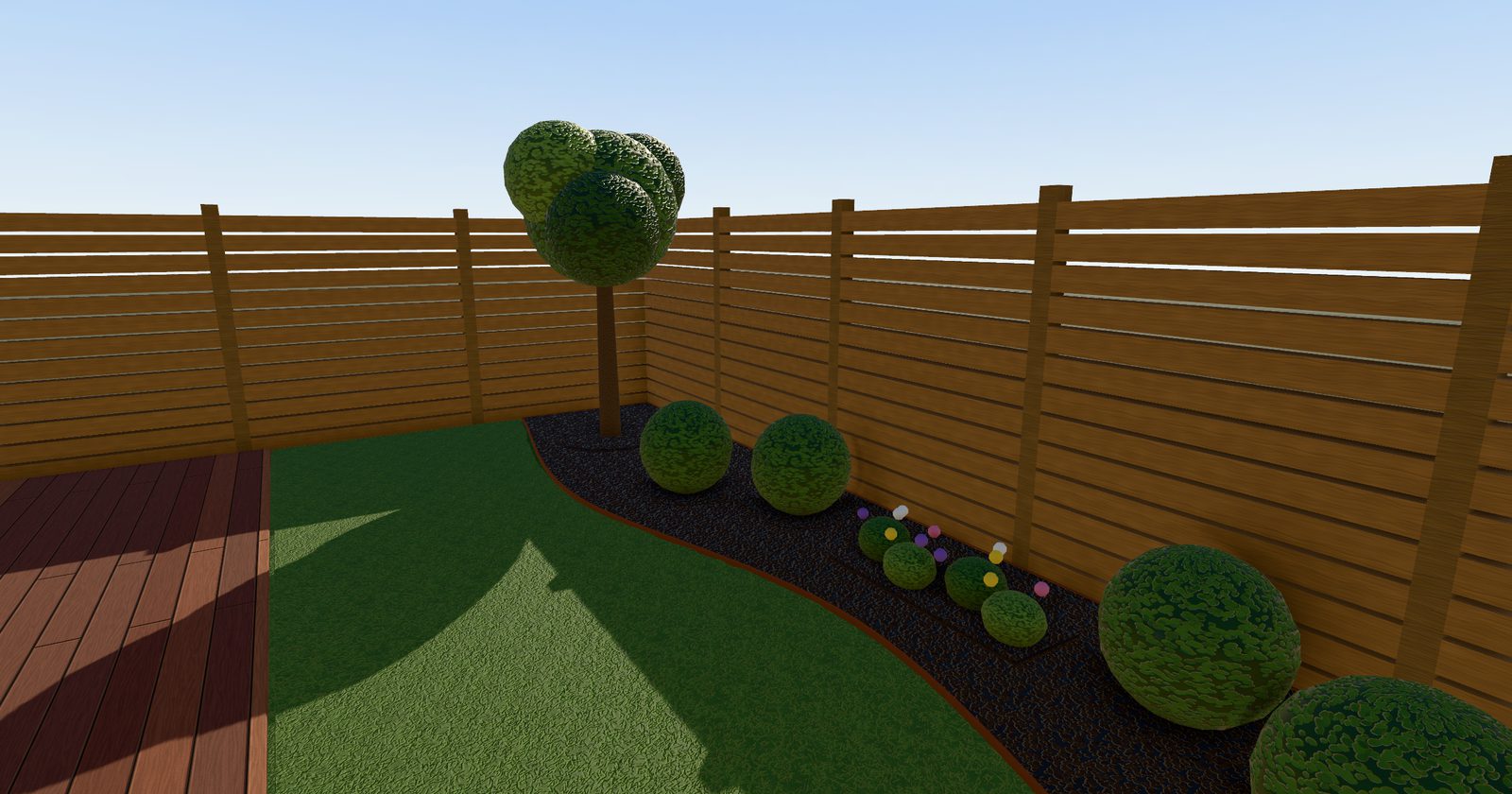
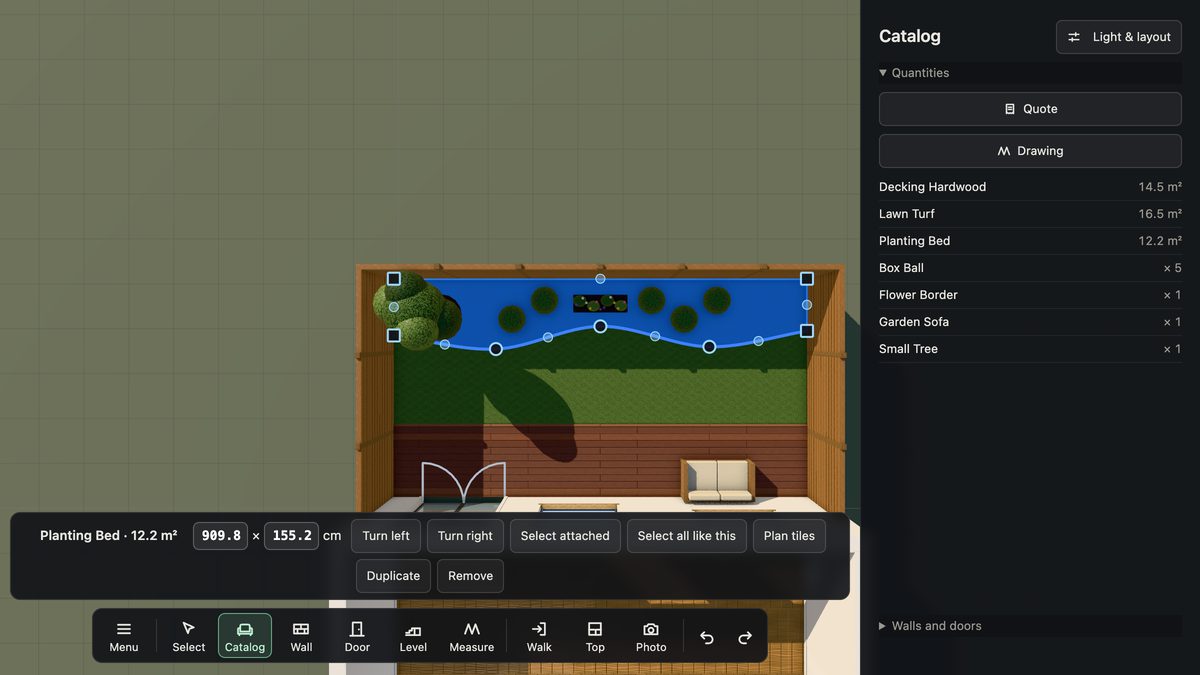
Trees and shrubs are placed one by one, where they will go, because each one is a decision. Here that is one small tree in the corner, five box balls 60 cm across, and a 1.2 m row of flowering plants by the middle. Open Quantities in the catalogue and each is counted, beside the bed's square metres: the beginning of the order for the nursery.
Then the perennials, per square metre
The rest of the bed is filled by density, the way nurseries sell it. Planting guides commonly give about three plants per m² for large perennials and grasses, five to seven for medium perennials, and nine to eleven for ground cover. Your grower's spacing for the actual varieties is the one to use.
For this border:
- The bed: 12.2 m².
- Taken by the structure: five box balls at 0.6 × 0.6 m is 1.8 m², and the row of flowering plants 0.5 m². The tree's crown is overhead, so the ground under it is still planted.
- Left to fill: 12.2 − 1.8 − 0.5 = 9.9 m².
- At six per m², a mix of medium perennials with some grasses: 59 plants, call it 60.
From the paced nine square metres, the same sums give 9 − 2.3 = 6.7 m², or 40 plants. That is the twenty short, and the half-day for a second delivery.
Price it from the same design
The Quote button above the quantities turns them into a quote: you type your own price per square metre for the bed's preparation and per piece for each plant, and the totals and VAT follow. Change the curve of the border with the client and the square metres, the quantities and the quote change with it.
And before any of that, the client can walk along the border at eye height and see the box balls against the fence. That is usually when they ask for the tree to move.
Try it
- Open the plan of the garden and press O for the view from above.
- Open Catalog, search for planting bed and pick it. Choose Curve on the bar and click along the edge of the border, back along the fence, then click the first point to close it.
- Read its square metres on the bar.
- Place the tree and the shrubs from the catalogue where they will go.
- Open Quantities for the counts and the square metres, and work out the perennials per m² from what is left.
What it does not do
- Every variety. The catalogue has trees, shrubs, hedges, planters and a flowering row, not every perennial, so the perennial count is your density times the area.
- Soil and mulch. It gives the square metres; the depth of compost or mulch you spread is yours to multiply.
Questions people ask
How many perennials per square metre?
Commonly about three for large perennials and grasses, five to seven for medium ones and nine to eleven for ground cover. Use your grower's spacing for the exact variety.
How do I work out how many plants a border needs?
Measure the bed's area, take off what the shrubs and trees take at ground level, and multiply what is left by the planting density.
How do I measure a curved flower bed?
Draw its edge on a plan at true size and let the software measure it. In Duimstok a bed drawn with Curve shows its square metres as you draw.
Can I price planting from a garden design?
Yes. Duimstok's Quote prices the bed per square metre and each plant per piece, at prices you type, so the quote follows the design.