
How many patio tiles do you need? Count them before you order
Area is not a tile count
The usual way to work out how many slabs a patio needs is to divide its area by the area of one slab and add ten percent. For a square patio laid to the slab, that is about right. For any other shape it is not, because every slab the edge passes through is a slab you cut, and most of what you cut off is waste.
The round patio in these pictures is 3.4 m across, in 60 × 60 cm slabs. As the planner lays it, it covers 9.15 m², and 9.15 divided by 0.36 m² is 26 slabs. Laid out properly it takes 34 or 35: about fifteen whole slabs and around twenty cut ones. That is a third more than the sum said, and the shortfall arrives on the day the patio is half laid.
Draw it at its real size
Duimstok is a 3D home on your own computer, and its garden coverings are what a garden centre sells, each at its real unit size. A few of them:
| Covering | Unit |
|---|---|
| Paving slabs and patio tiles | 60 × 60 cm |
| Concrete tiles | 30 × 30, 50 × 50 and 40 × 60 cm |
| Belgian bluestone | 40 × 40 cm |
| Concrete pavers | 21 × 10.5 cm |
| Brick paving | 20 × 10 cm |
| Clay and tumbled pavers | 20 × 5 cm |
| Granite setts | 10 × 10 cm |
| Ceramic wood-look planks | 120 × 30 cm |
| Decking boards | 240 × 15 cm |
Draw the patio as it will be. Drag out a rectangle, or draw a curve point by point. The garden design guide covers the drawing. Paving is never stretched to fit a shape: the joints you see are the joints you would lay.
Read the quantities
The catalogue panel's Quantities list keeps a running total of the whole design: each covering's area in square metres, measured off its real outline, a path's length as well, and every other piece counted.
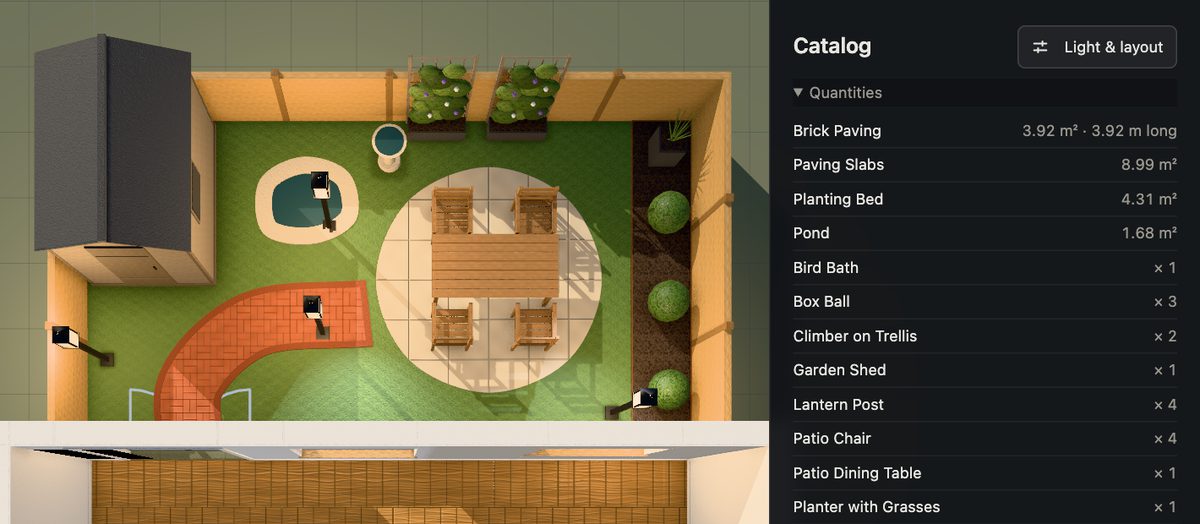
Area is the right number for anything loose, and the first number to sanity-check for anything laid. For slabs and pavers, the next step does the counting.
Plan tiles: whole and cut, five ways
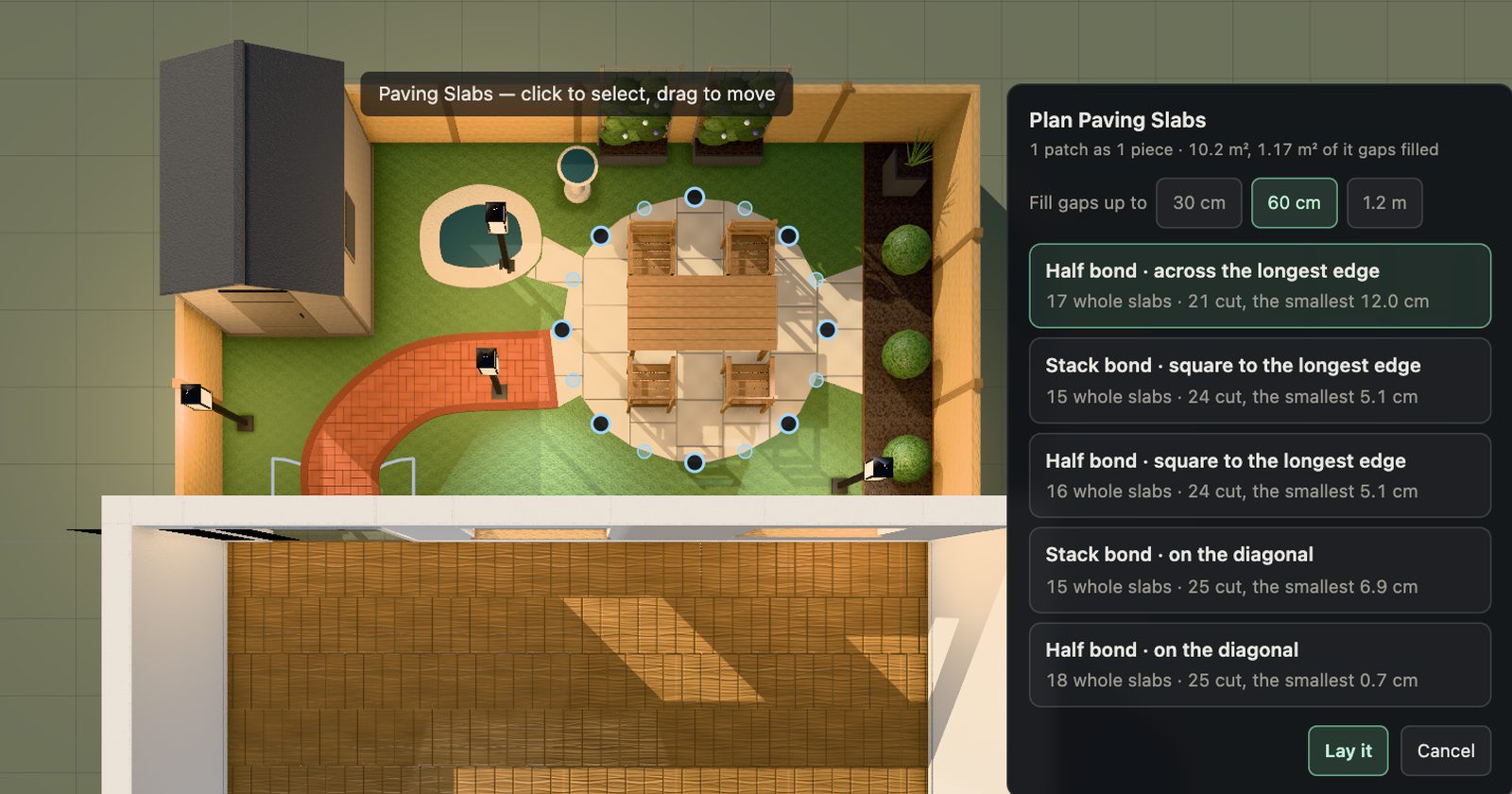
From above (O), click the patio, or Shift-click several patches of the same covering, and choose Plan tiles. The planner joins the patches into one piece, fills the narrow gaps they leave against walls, fences and other paving, and offers up to five ways to lay it. Each one is a bond and a direction, with a count of whole and cut units and the narrowest cut piece. Click an option to see it laid in place, and Lay it when you have chosen.
| Layout | Slabs | Smallest cut |
|---|---|---|
| Half bond, across the angled edge | 17 whole, 18 cut | 15.2 cm |
| Stack bond, square to the longest edge | 15 whole, 19 cut | 4.0 cm |
| Half bond, along the angled edge | 16 whole, 18 cut | 13.7 cm |
| Stack bond, on the diagonal | 15 whole, 20 cut | 3.1 cm |
| Stack bond, along the angled edge | 14 whole, 21 cut | 3.5 cm |
The totals barely move, 34 to 35 slabs, but the smallest cut does. A 3 or 4 cm sliver of slab is fiddly to cut, likely to snap, and looks like a repair. The half bond across the angled edge leaves nothing narrower than 15 cm, and that is the one to lay.
The gap setting matters too. At the default 60 cm the planner also takes in the strip, up to 45 cm wide, between the patio and the planting bed: too narrow to mow, so paving it is often right. The patio grows to 10.2 m² and the best layout becomes 17 whole slabs and 21 cut. That is a design decision, so it is a button rather than a guess: 30 cm, 60 cm or 1.2 m.
A brick path, counted
Small units multiply the effect. The curved path from the garden doors is a metre wide and 3.9 m long, in 20 × 10 cm bricks. By area its 3.92 m² is about 196 bricks. Planned, with its narrow gaps filled, it covers 4.41 m², and the options run from 261 to 266 pavers, of which 84 to 95 are cut.
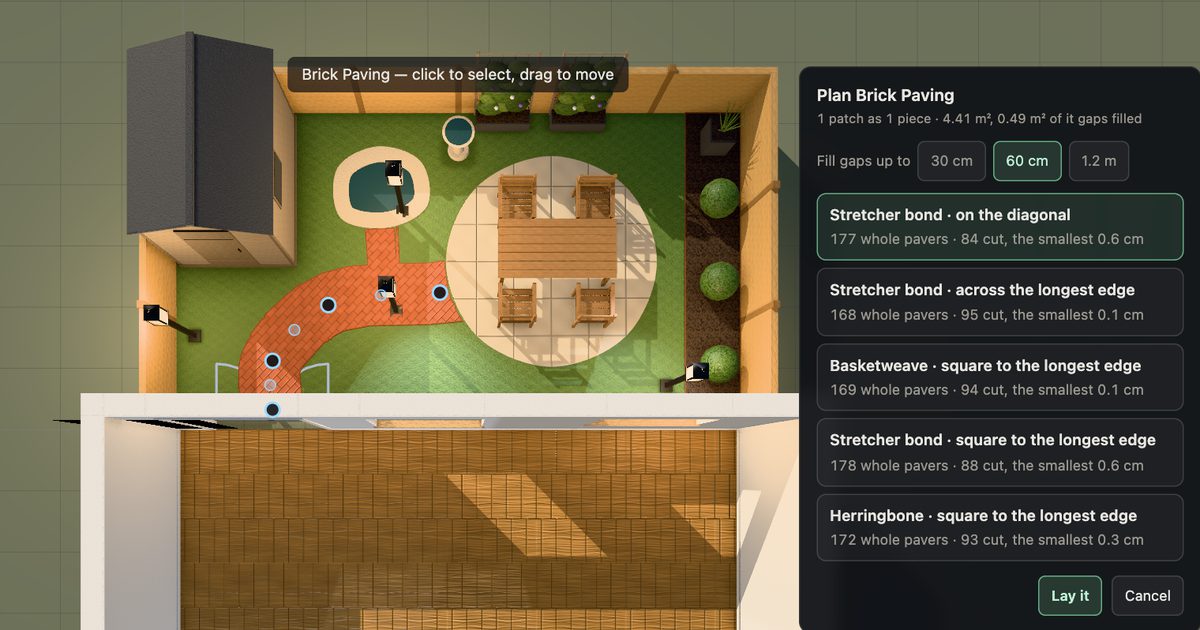
On a curve almost every brick along both edges is cut, so a third of the path is cut pieces whichever bond you choose. Pick the pattern for how it looks. The count tells you what to order.
Gravel, bark and sand: area times depth
Loose materials are sold by volume or weight, and Duimstok gives you the area. The rest is one multiplication. The planting bed here is 4.31 m²; at 5 cm of bark that is 4.31 × 0.05 = 0.22 m³, or about 220 litres. Check the litres on the bag you are buying.
Gravel works the same way, then by weight: roughly 1.5 to 1.7 tonnes per cubic metre depending on the stone, which your supplier will confirm. Duimstok deliberately stops at square metres. The depth is your decision, and a figure in tonnes would hide that.
Before you order
- Add a margin. The count is exact for the outline you drew, with one unit for every cut piece. Add 5 to 10% for breakage and the odd bad cut.
- Check the real site. The count is only as good as the outline. Measure the ground before you buy; the measurement notice says more.
- Order from one batch. Colour varies between production runs, so buy the margin with the rest rather than topping up later.
Questions people ask
How many 60 × 60 cm slabs do I need for a round patio?
More than the area suggests. For a round patio 3.4 m across, Duimstok's planner counted 34 to 35 slabs depending on the layout, about twenty of them cut, where dividing the area by one slab gives 26.
How much extra should I order for cuts and breakage?
Usually 5 to 10% on top of the count. Duimstok counts whole and cut pieces for the outline you drew but adds no margin of its own.
Does Duimstok work out gravel or bark?
It gives the area in square metres off the real outline. Multiply by the depth you want to lay for the volume; it does not convert to bags or tonnes.
How do I get the paving calculator?
It is part of Duimstok, a desktop app for macOS, Windows and Linux. Download it from gemelyn.com and email info@gemelyn.com for a licence; your design stays on your own computer.