
How deep should a pool be? Flat or with a deep end
Standing in it, or swimming in it?
The pool builder asks one question you have not thought about: "Flat floor, or a deep end?" The children want to touch the bottom. You want to swim a few strokes without your knees on the floor. Someone at work says a pool must be two metres deep. The builder needs an answer by Friday, because the depth decides how big the hole is.
It helps to see the two pools side by side before you choose, with the water you will pay to fill. Here is that comparison for one small garden pool, built in Duimstok.
The pool: 6 × 3 m in a small back garden
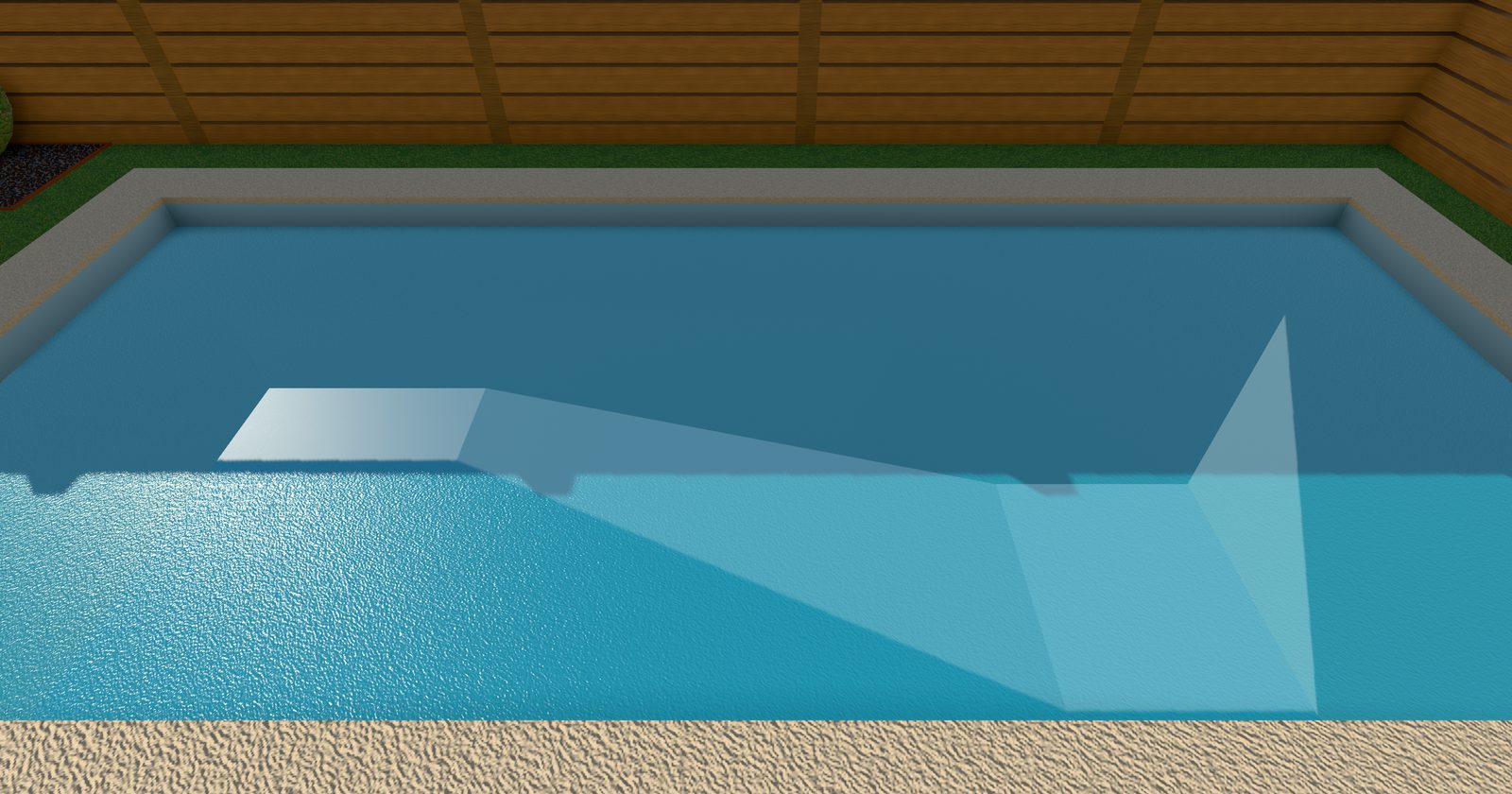
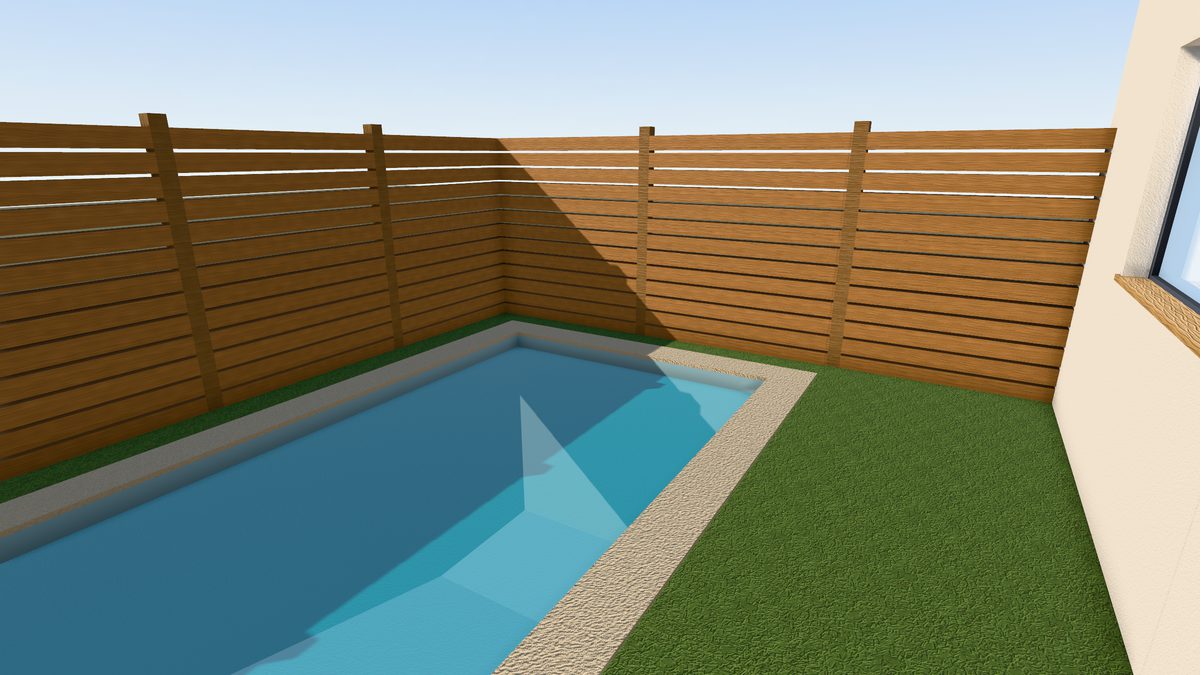
The garden is the 9.10 × 4.80 m back garden we use for every example. The pool runs along it, 6.00 × 3.00 m with its stone coping, a lounger on the deck by the house beside it. The coping is 30 cm wide, so the water inside it is 5.40 × 2.40 m, and it stands 15 cm under the top of the coping.
We built the same pool twice. Once with one depth everywhere, and once with a shallow end by the deck and a deep end at the back fence.
Two floors: 1.35 m everywhere, or 1.0 m to 1.8 m
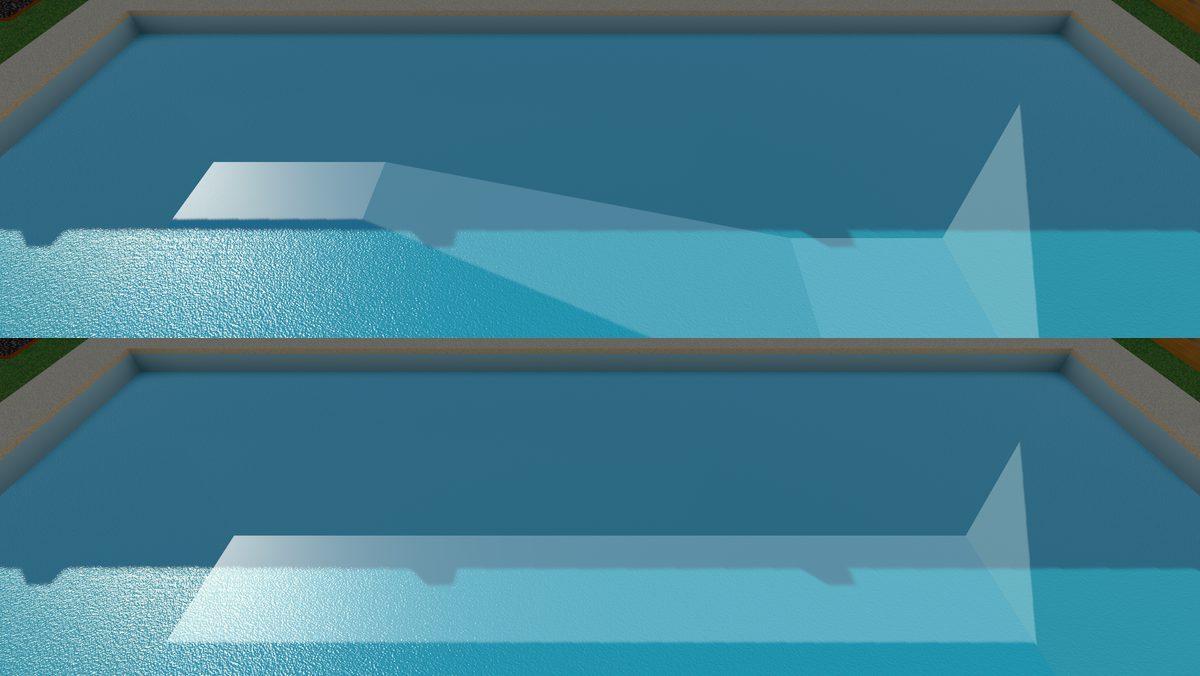
The flat pool has 1.35 m of water from one end to the other. That is the depth family pools are usually built to: most adults can stand anywhere, and there is room to swim.
The pool with a deep end has 1.0 m of water at the shallow end and 1.8 m at the deep end. The floor stays at 1.0 m for the first 1.5 m, slopes down, and stays at 1.8 m for the last 1.5 m. Builders in Europe offer about 1.0 to 1.2 m at the shallow end and 1.8 to 2.0 m at the deep end for a pool that is not built for diving, so this sits at the low end of both.
At 1.0 m, most adults stand with their chest out of the water, and older children can stand too. At 1.8 m, most adults cannot touch the floor with their head above water. That is the real choice: a pool where everyone stands everywhere, or one with a part you can only swim in.
What the deep end adds: water and liner
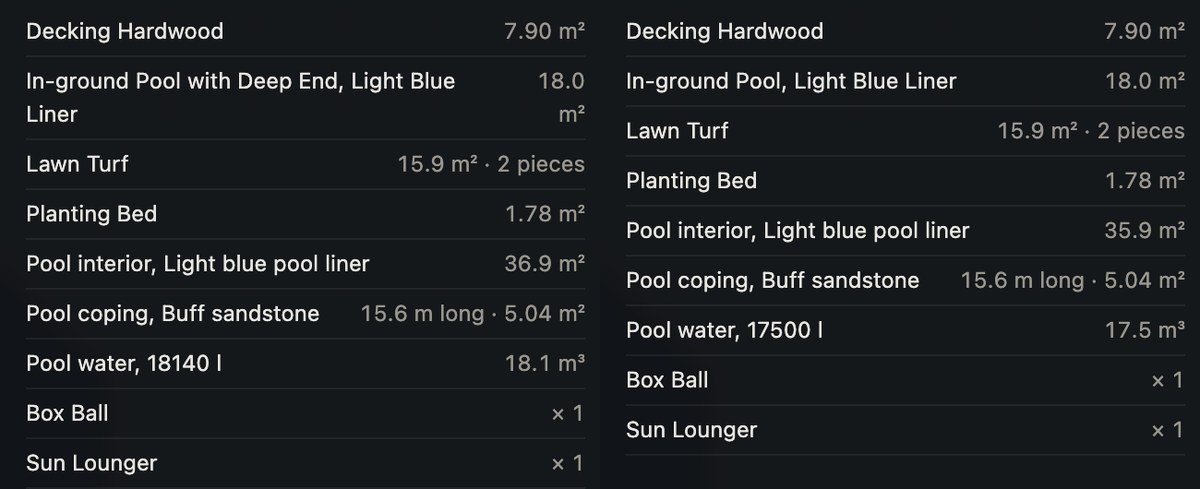
The Quantities list measures both pools from their real shape:
- Flat: 17,500 litres of water (17.5 m³), 35.9 m² of liner, 15.6 m of coping.
- Deep end: 18,140 litres (18.1 m³), 36.9 m² of liner, 15.6 m of coping.
So on this pool the deep end costs 640 litres more water and about 1 m² more liner. Less than most people expect, and for a simple reason: the average depth only goes from 1.35 m to 1.40 m. What you gain at the deep end you mostly give back at the shallow end.
Where a deep end costs more is the hole. The digger has to go about 45 cm deeper at the back fence than for the flat pool, and that earth has to go somewhere. Ask your builder what the extra depth does to their price; the water and the liner hardly move.
A short pool has no room for a deep end
A slope needs length. Each end is flat for 1.5 m, and the slope needs room between them, so a pool much under 4 m long ends up with a short, steep slope, or none. In Duimstok a pool shorter than 4 m along its length is simply built flat, at 1.40 m, halfway between the two ends.
On a 6 m pool like this one, the slope is short too: the floor drops 80 cm over a couple of metres. On an 8 m pool it would be much gentler. If the deep end matters to you, give the pool length rather than width.
Choose it by walking round it
In Duimstok you change one pool into the other without drawing it again: select the pool, open the catalog and pick the version with a deep end, and it is laid again in the same place, the same size. The Quantities list changes with it. Turn the pool round and the deep end turns with it, so you can put it away from the deck where people sit with their feet in the water.
Then press Walk and stand where you would get in. You see how much of the garden the pool takes, and whether the lounger still has room beside it.
Try it
- Open your plan, press O for the view from above and open Catalog.
- Search for pool and pick In-ground Pool, Light Blue Liner, or one of the other linings.
- Drag it out on the lawn and type its length and width on the bar.
- With the pool selected, pick In-ground Pool with Deep End, Light Blue Liner: it is laid again in its place.
- Use Turn left or Turn right to put the deep end where you want it, then open Quantities for the water and the liner.
Limits worth knowing
- The depths are fixed: 1.35 m for a flat pool, 1.0 m to 1.8 m for one with a deep end.
- The deep end is drawn for swimming. Duimstok does not draw a diving pit or a diving board.
- It does not plan the filter, the pump, the heating or the cover, and it does not count the earth that is dug out.
Questions people ask
What is a good depth for a family pool?
Many family pools are built to one depth of about 1.2 to 1.4 m, so that most people can stand everywhere. A pool with a deep end usually goes from about 1.0 m to 1.8 m.
Does a deep end use much more water?
Less than you think. On a 6 × 3 m pool, going from 1.35 m flat to 1.0–1.8 m adds 640 litres, because the average depth only rises by 5 cm.
How many litres is a 6 × 3 m pool?
With 5.40 × 2.40 m of water inside a 30 cm coping, about 17,500 litres at 1.35 m deep, or 18,140 litres with a deep end from 1.0 to 1.8 m.
Can a short pool have a deep end?
Only with a steep slope. Each end needs a flat part and the slope needs room between them, so under about 4 m long a flat floor makes more sense.