
Pond edge: stone, deck, lawn or pebble beach?
The black collar round the water
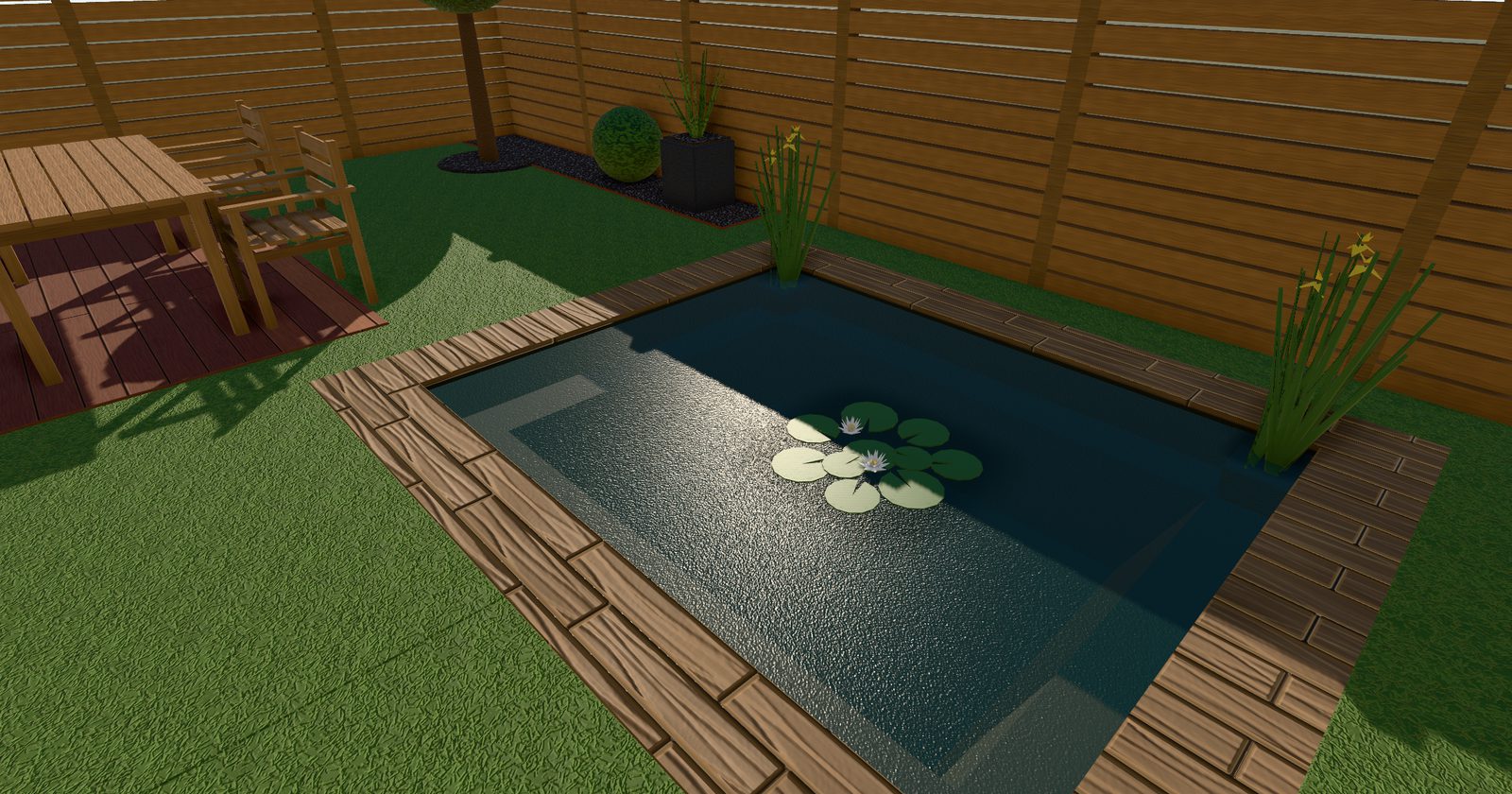
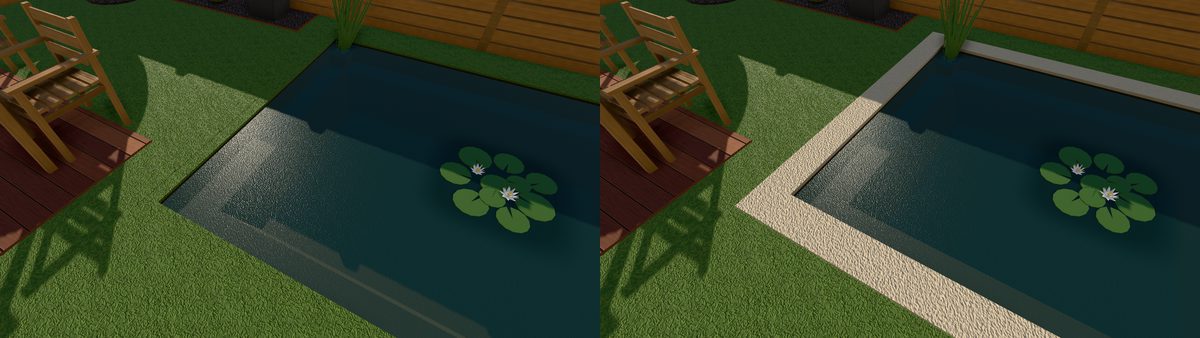
The hole is dug, the liner is in and the water has cleared. And all the way round, between the water and the grass, runs a collar of black rubber. Nobody planned it. The size and the depth were chosen with care, and the edge was left for later.
The edge is the part of a pond you look at every day, and it decides more than the look: how much water the same hole holds, where you can sit, and how a bird or a frog gets in and out. Here is one pond with four edges, built in Duimstok, with what each one does to the water.
One pond, 3.6 × 3.0 m, four times
The garden is the 9.10 × 4.80 m back garden we use for every example: a deck by the house, a lawn and a bench by the fence. The pond is drawn 3.60 × 3.00 m each time, 10.8 m² of garden. Under every edge the dig is the same shape: a planting shelf 25 cm wide and 20 cm under the water, then a middle 60 cm deep.
Only the edge changes. The pond's size is its outline, edge included, so a wider edge leaves less water inside the same outline.
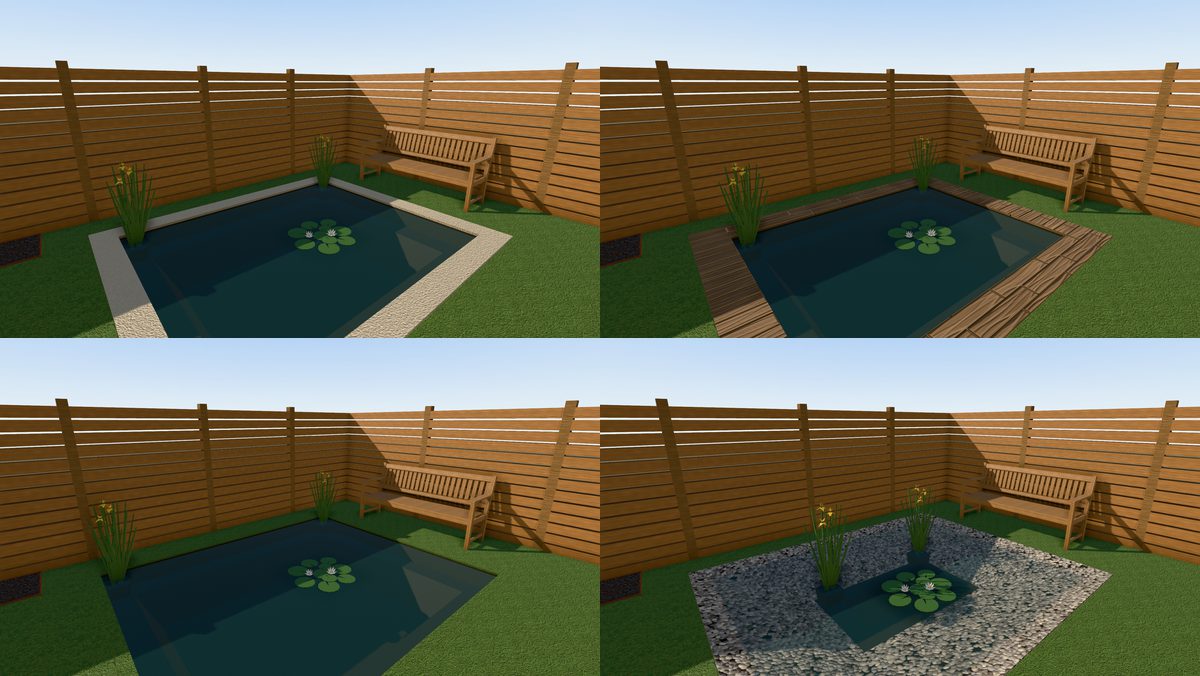
Stone coping: the tidy one
Flat stones 25 cm wide lie round the water, 3 cm above the ground. The water is 3.10 × 2.50 m and the Quantities list gives 3,280 litres, with a liner and an underlay of 500 × 450 cm.
A coping gives a firm, level line to stand on and to mow up to. It suits a formal pond near a terrace.
Deck edge: the one you sit on
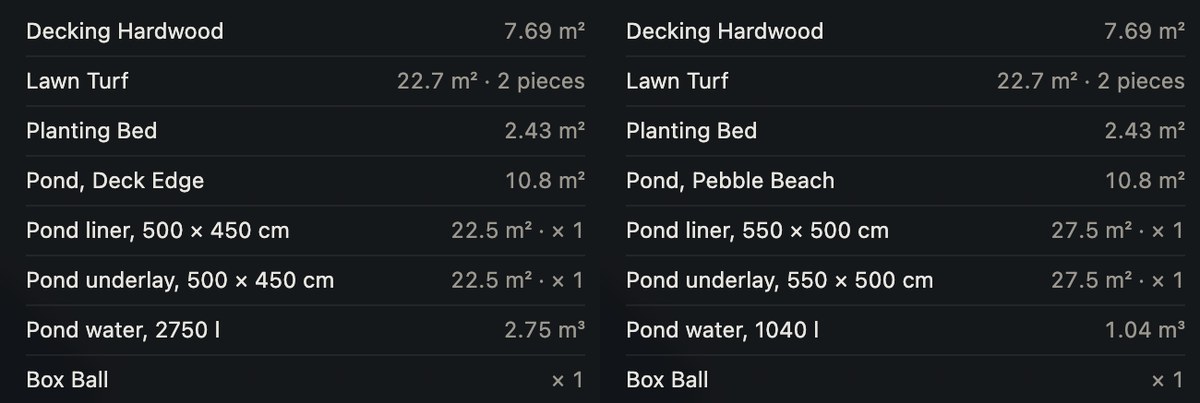
Deck boards 35 cm wide run round the pond, flush with the water's edge, so you can sit on the boards with your feet over the water. The wider edge takes room from the water: it is 2.90 × 2.30 m and holds 2,750 litres, 530 fewer than with the coping. The liner is the same 500 × 450 cm.
Lawn edge: the most water
The turf runs to the water and the liner is tucked under it, 10 cm in. Nothing shows but grass and water. Because the edge is so narrow, the water is 3.40 × 2.80 m and holds 4,180 litres: 900 more than with the coping, from the same outline. The liner grows to 550 × 500 cm.
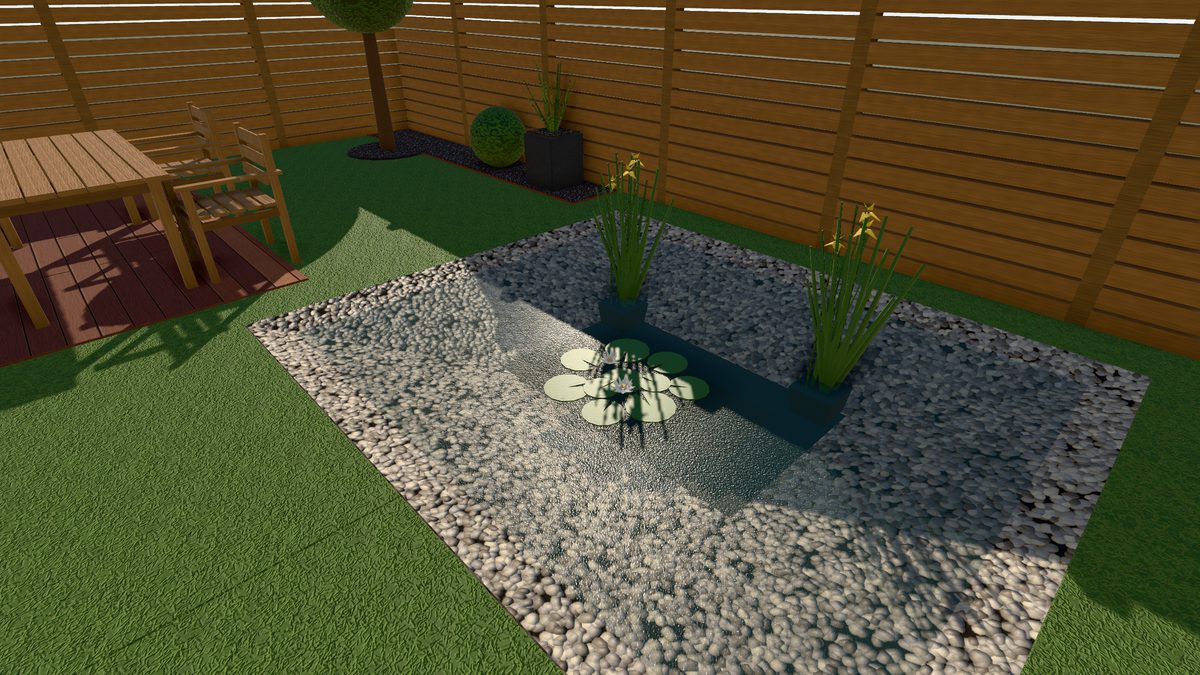
Pebble beach: the one for wildlife
Rounded pebbles slope from the lawn into the water at 1 in 4. The first 20 cm are dry; then the pebbles carry on under the water for another 80 cm until they reach the planting shelf. A shallow shore like this is what a wildlife pond is given, so birds can bathe and frogs can climb out.
It costs water. On each side a full metre of the outline is beach, so this pond holds only 1,040 litres, under a third of the coping version, on a 550 × 500 cm liner. In a pond much narrower than 3 m there is no room left for a deep middle at all. If you want a beach and depth, draw the pond bigger, or accept a shallow one.
The four, side by side
- Stone coping, 25 cm: 3,280 l of water, liner 500 × 450 cm.
- Deck edge, 35 cm: 2,750 l, liner 500 × 450 cm.
- Lawn edge, 10 cm: 4,180 l, liner 550 × 500 cm.
- Pebble beach, 1 m of slope: 1,040 l, liner 550 × 500 cm.
Try it
- Open your plan, press O for the view from above and open Catalog.
- Search for pond and pick Pond, Pond, Deck Edge, Pond, Lawn Edge or Pond, Pebble Beach.
- Lay it in the garden, then type its size on the bar, for example 360 and 300.
- Press Walk and look at the edge from where you will sit.
- Open Quantities for the liner, the underlay and the water.
- To compare, press Remove and lay the next edge at the same size.
Limits worth knowing
- A pond takes one edge all the way round. A beach on one side and a coping on the others is not offered yet.
- The shelf and the depth are fixed: 25 cm wide, 20 cm under the water, and 60 cm in the middle.
- The liner size is the app's sum for this shape. Check it with your supplier before you order.
Questions people ask
How do you hide the pond liner at the edge?
Cover it with the edge: stones laid over it, deck boards over it, turf laid over the tucked-in liner, or pebbles on a shallow slope. In all four the edge reaches down to the water, so no liner shows between water and edge.
What is the best edge for a wildlife pond?
A shallow sloping shore on at least one side, so animals can walk in and out. A 1 in 4 pebble beach does that, and takes about a metre of the pond's width on each side it is on.
How much water does a 3.6 × 3 m pond hold?
With a shelf and a 60 cm deep middle, between about 1,000 and 4,200 litres, depending on the edge: 4,180 l with a lawn edge, 3,280 l with a stone coping, 2,750 l with a deck edge and 1,040 l with a pebble beach.