
Where should the sandpit go? Check from the window
The corner that looked perfect
The back corner seemed the obvious place. Out of the way, behind the low hedge, where the lawn is no use for anything else. The sandpit goes in on a Saturday, the sand arrives on the Sunday, and on Monday you are at the kitchen window with the kettle on. You can hear the digging. You cannot see a thing. So every few minutes you walk to the door to look, and by Wednesday the sandpit is a place nobody plays in alone.
Where a sandpit goes is not really a question about the garden. It is a question about the spot inside the house where you spend most of the day, and what you can see from there. You can check that before a spade goes in. Here it is worked out in a real garden in Duimstok.
The garden: 9.1 by 4.8 metres and a low hedge
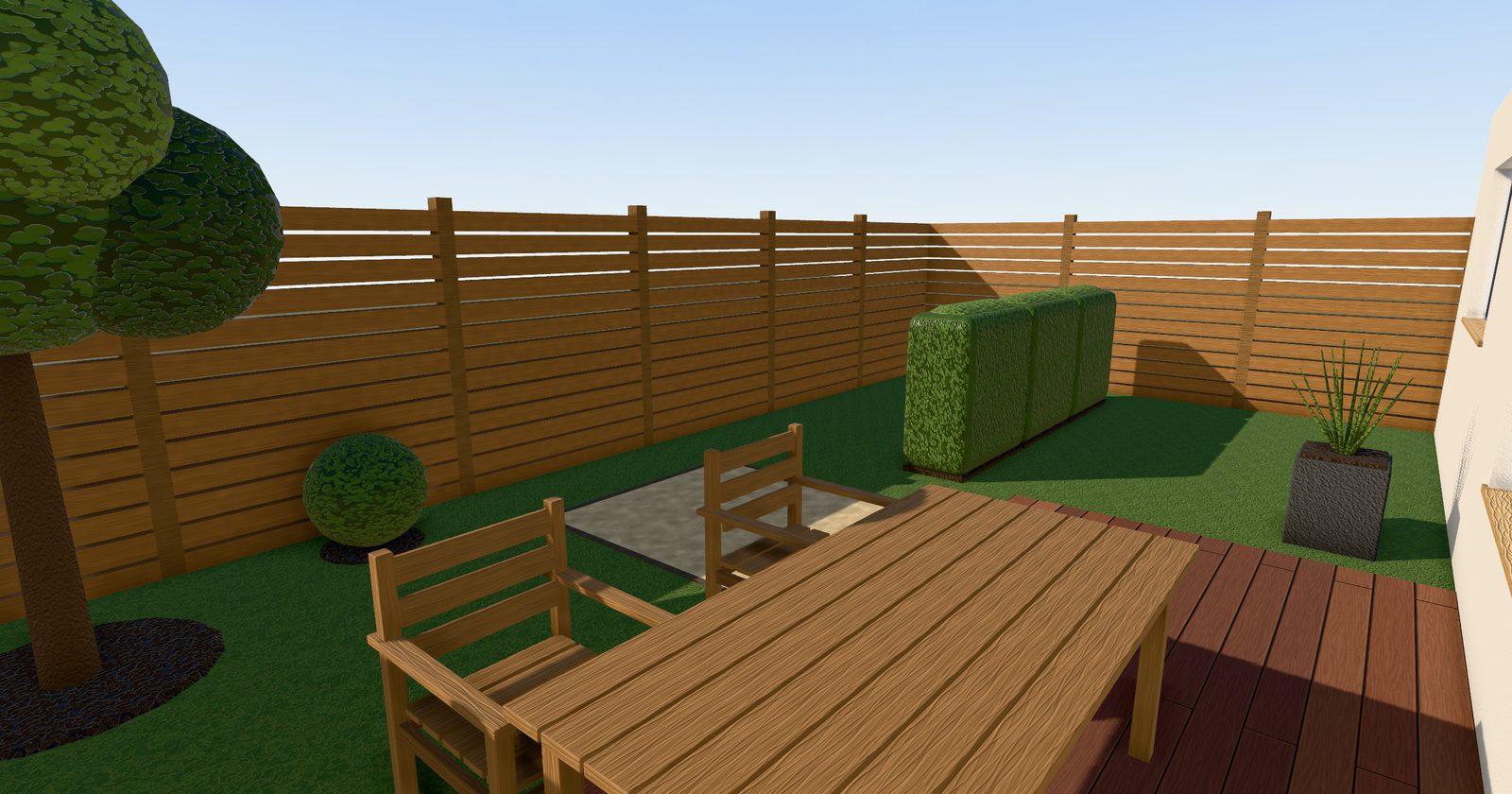
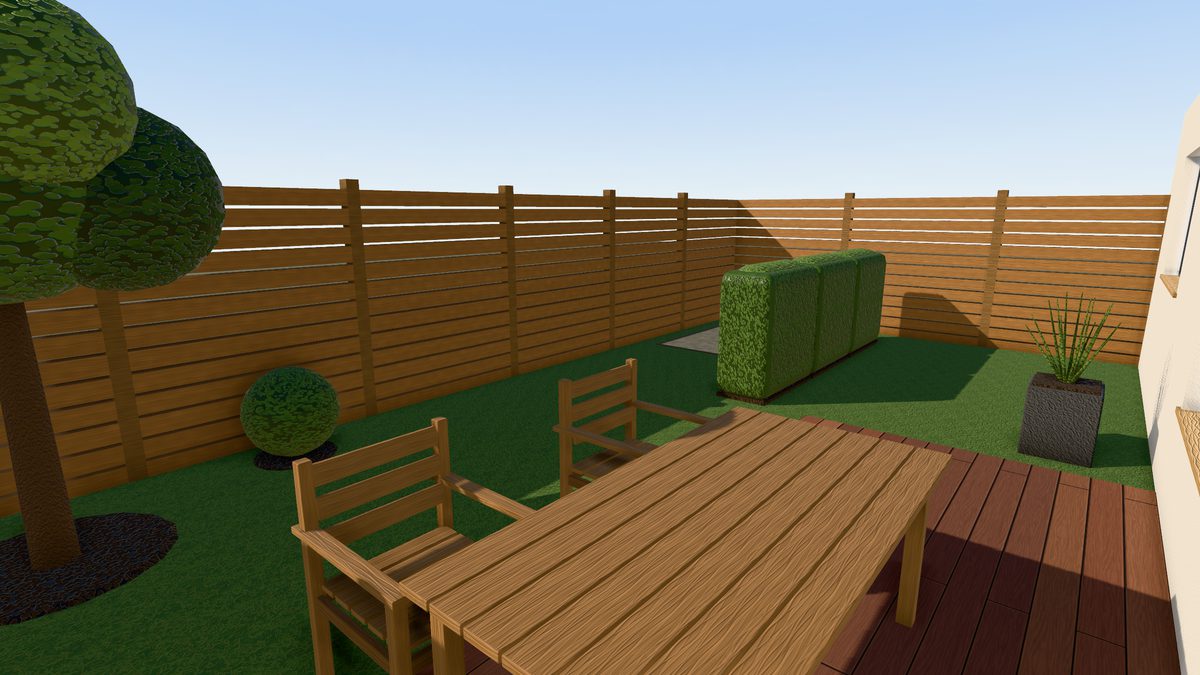
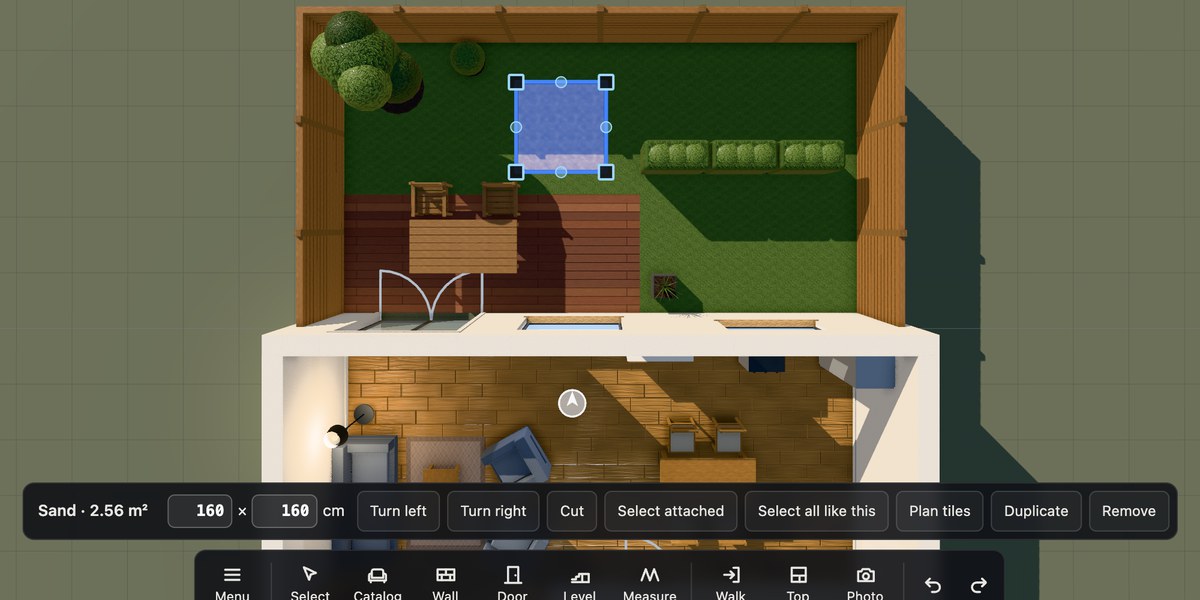
The example is a back garden 9.1 m wide and 4.8 m deep behind a living-kitchen. Against the house is a hardwood terrace of 11.0 m² with a table and two chairs. A Box Hedge 1.2 m high and 50 cm thick runs 3.3 m across the right-hand side, 2.45 m out from the house wall, to give the back corner some privacy. The rest is lawn.
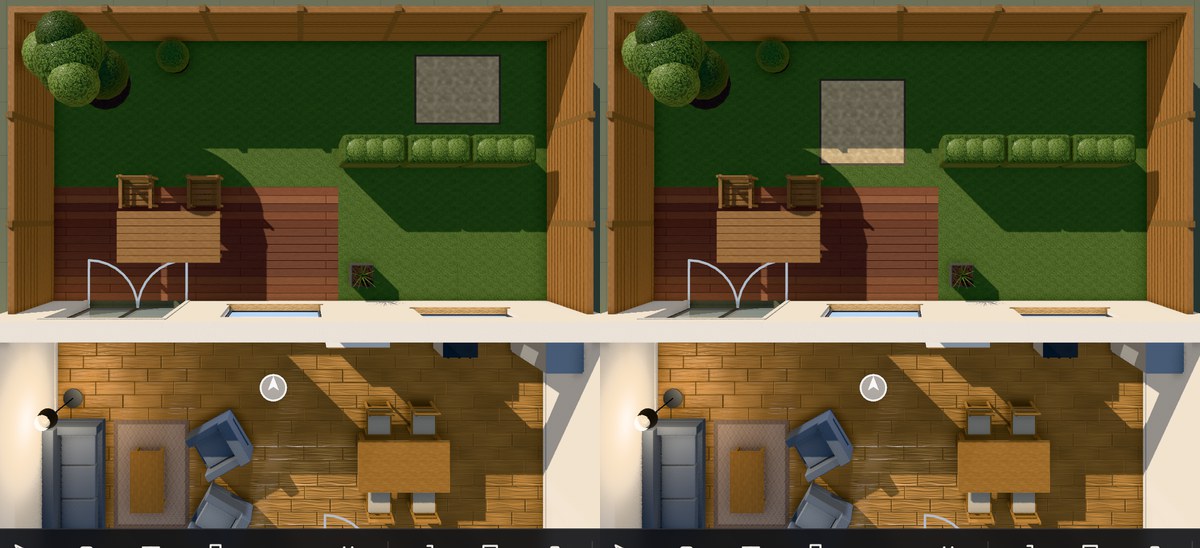
The sandpit is the catalogue's Sand: yellow play sand in a timber edging. It comes 1.60 × 1.60 m, 2.56 m², and you can type any other size on the bar. It is tried in two places: tucked into the back corner behind the hedge, and on the lawn just past the terrace, 40 cm from the decking.
Start the walk where you actually stand
Normally a walk through the design starts wherever the plan put it. Since version 1.0.11 you can move that start yourself. Press O for the view from above and there it is, a white disc with an arrow. Drag it to your spot: here, inside the living-kitchen, 1.3 m back from the middle window. Click it and turn it with Turn left or Turn right until the arrow points into the garden. The start is saved with the design.
Now press Walk. The first thing you see is the garden from where you will really be standing, through the window, with the frame and the sill in the way.
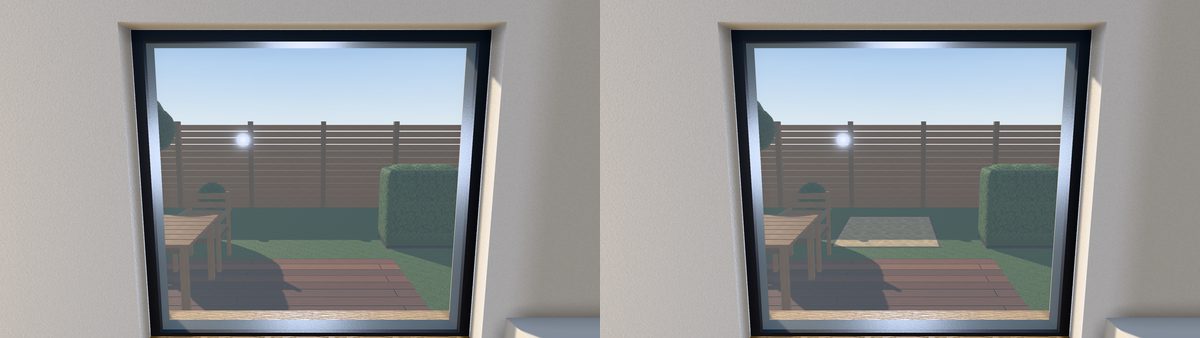
Behind the hedge, the sandpit is gone. Not partly hidden: gone. On the lawn past the terrace it is the first thing in the window, a little to the right of the table.
Why a 1.2 m hedge hides the whole corner
The walker's eye is 1.65 m above the floor, a standing adult. From there to the front of the hedge is 4.05 m, and the hedge top is 1.2 m high, so the line of sight drops 45 cm over those 4.05 m. Carry that line on and it reaches the ground 14.85 m from your eyes. This garden ends 6.4 m from them. Nothing on the ground behind the hedge can be seen from the window, anywhere in the corner.
A child sitting in the sand is not much better off. Over the sandpit, 4.85 to 6.15 m from the window, the line of sight passes between 1.11 m and 0.97 m above the ground. Anything lower than about a metre behind that hedge is out of sight. A garden shed, a trampoline or a bank of tall grasses does the same as the hedge, and the sum is the same.
What else the spot decides
Being seen is the first test, not the only one. The same plan answers the rest in numbers.
- Distance to the terrace. At 40 cm from the decking, sand will come onto the terrace on small feet. A metre of lawn in between gives it somewhere else to fall. Move the sandpit on the plan and see the gap change.
- The lawn it takes. A 1.60 × 1.60 m sandpit takes 2.56 m² of lawn. In a garden with 30 m² of grass that is close to a tenth, so put it where it does not cut the lawn into two strips.
- The sand to order. Quantities lists the sandpit as 2.56 m². Multiply by the depth of sand you want: a 30 cm fill is 0.77 m³, a 20 cm fill 0.51 m³. Ask the supplier how many bags or what size of big bag that is.
So where should it go?
Where you can see it from the spot you are at most, with nothing over about a metre between you and it. In this garden that is the lawn just past the terrace, straight out from the middle window, not the corner behind the hedge. In yours it may be somewhere else: a different window, a kitchen at the front, a hedge you are planning but have not planted yet. Put the start where you stand, put the sandpit where you think, and press Walk. It takes a minute, and the sand is a lot of barrows to move twice.
Try it
- Open your plan and press O for the view from above.
- Open Catalog, search for sand, pick Sand and drag it out on the lawn. Type the size on the bar, for example 160 × 160.
- Find the white disc with the arrow, the walker's start. Drag it to the spot inside where you spend most of the day.
- Click it and press Turn left or Turn right until the arrow points into the garden.
- Press Walk. Can you see the sandpit? If not, press O, drag it somewhere else and walk again.
- Open Catalog, then Quantities, for the area to multiply by the depth of sand.
Questions people ask
Where is the best place for a sandpit in the garden?
Where you can see it from the spot in the house where you spend most time, with nothing higher than about a metre in between. In the example, a 1.2 m hedge 4 m from where you stand hid everything on the ground behind it, right up to the back fence.
How much sand do I need for a sandpit?
Multiply the area by the depth. A 1.60 × 1.60 m sandpit is 2.56 m², so a 30 cm fill takes 0.77 m³ of sand and a 20 cm fill 0.51 m³.
How far from the terrace should a sandpit be?
Close enough to see, far enough that sand is not carried straight onto the paving. A metre of lawn between the sandpit and the terrace gives the sand somewhere to fall before the paving.