
What size rug for a living room? 200 × 140 or 290 × 200
The rug that shrank on the way home
In the shop, rolled out on the floor between the displays, a 200 × 140 cm rug looks generous. At home it ends a hand's width in front of the sofa, the armchairs stand on bare boards, and the rug sits in the middle of the room like a mat someone forgot to put away.
The size of a rug only means something next to the furniture it belongs to. So here are three rugs tried under the same sofa, the same two armchairs and the same coffee table, in one living room built at true scale in Duimstok.
The room and what stands in it
The living room is 4.80 by 3.90 m on its wall lines, 18.7 m², with the door in one corner and a window of 2 m in the opposite wall. Against the long wall stands a three-seat sofa of 210 × 90 cm. Facing it are two armchairs of 85 × 88 cm, with a coffee table of 110 × 60 cm between them. A bookcase stands on the side wall.
From the back of the sofa to the backs of the armchairs, the group is 3.14 m deep and 2.10 m wide. That is the area a rug has to tie together.
200 × 140: the rug for the coffee table
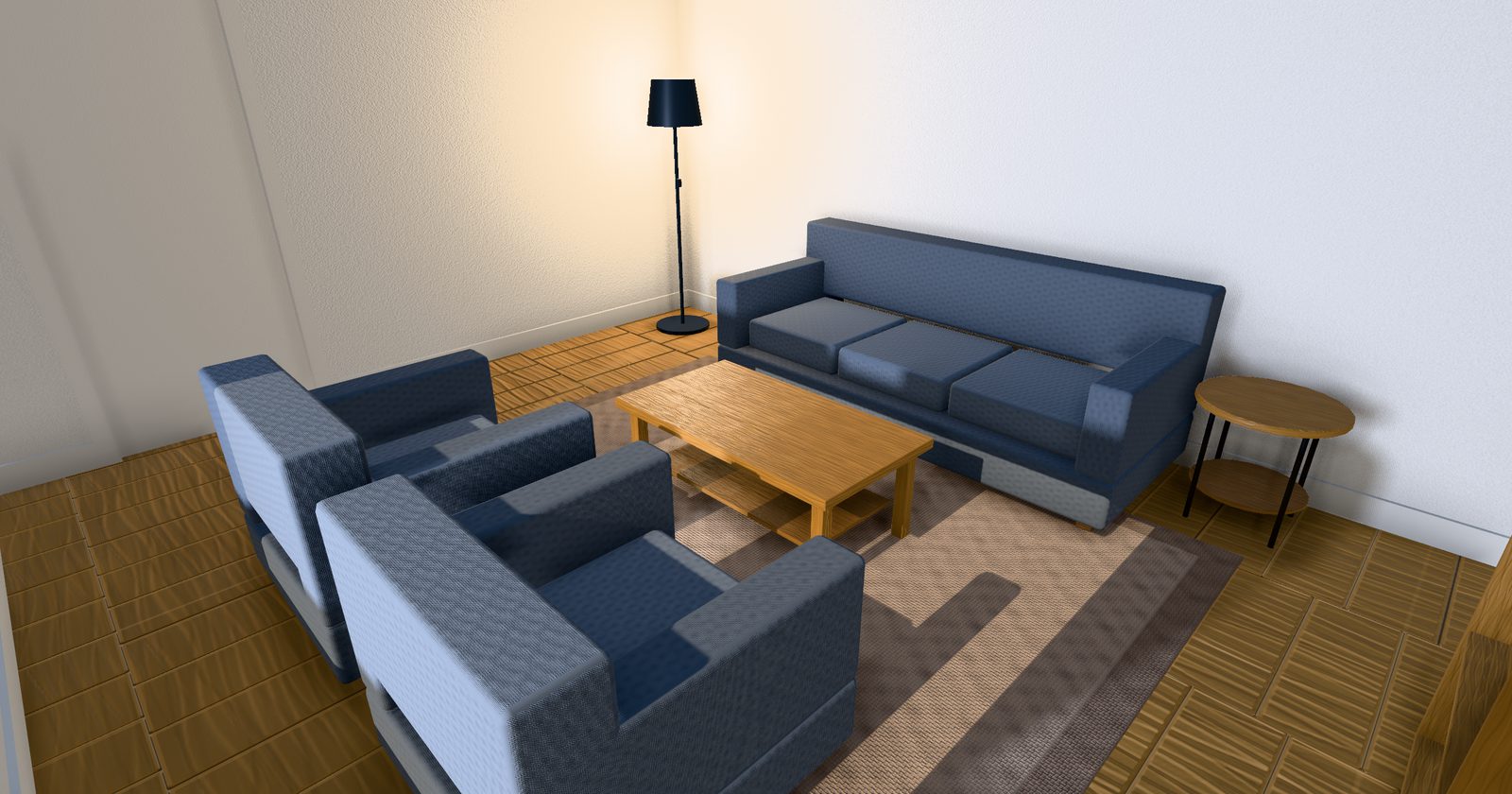
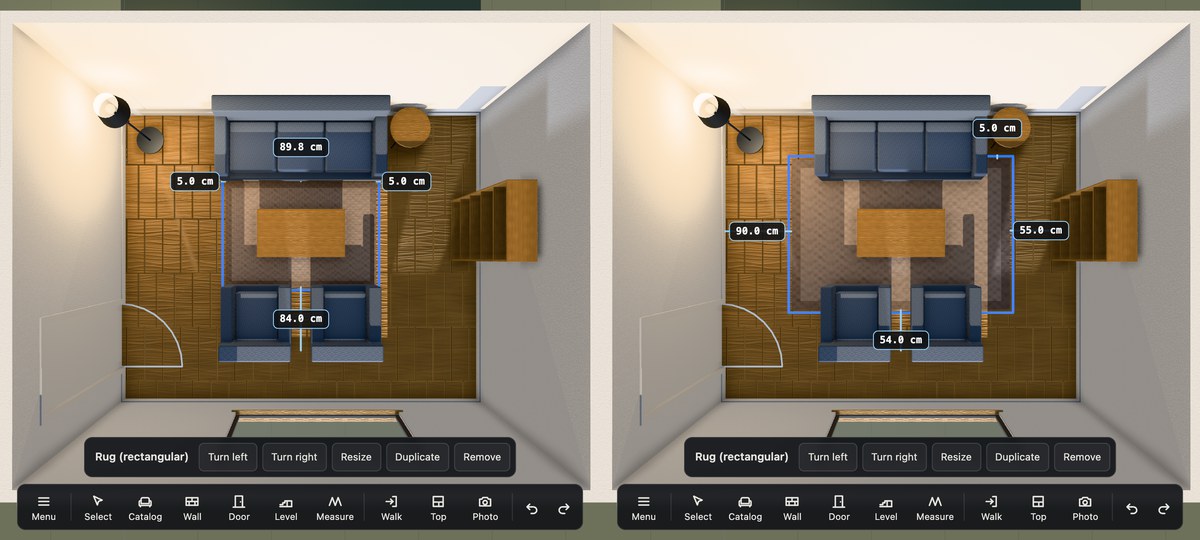
Laid under the coffee table, the 200 × 140 rug stops at the front edge of the sofa and runs under the front of the armchairs by 4 cm. Not one leg of the sofa is on it. Selected from above, it shows 5 cm to spare at each end of the sofa: it is narrower than the sofa it belongs to.
From where you stand in the room, it reads as a small island. The sofa and the chairs float around it rather than on it, and the room looks smaller, not bigger.
290 × 200: the front legs on, a border left
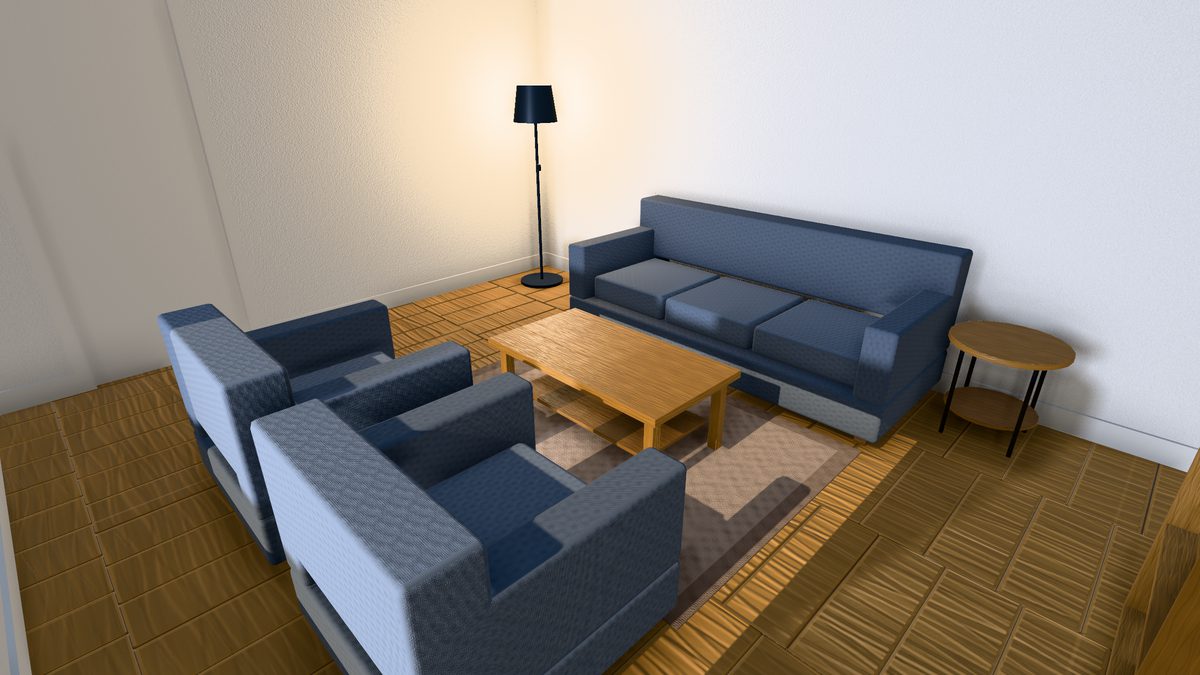
The common advice is to get the front legs of every seat onto the rug. Here that takes a rug of 290 × 200 cm. Laid with its middle under the coffee table, it runs 30 cm under the front of the sofa and 34 cm under the front of each armchair. It is 40 cm wider than the sofa at each end, so the sofa sits on it rather than across it.
And the room keeps its floor. Selected, the rug shows 90 cm of bare boards to the wall on the door side and 55 cm to the bookcase on the other. That border is what makes a large rug look chosen rather than wall-to-wall.
A 160 × 230 rug, the size between the two, only just makes it: centred under the table it runs 10 cm under the sofa and 14 cm under the armchairs, and it is 10 cm wider than the sofa at each end. Move it a little and one side comes off. With chairs opposite the sofa, the extra 40 cm of depth in the larger rug is what holds them in.
A round rug of 160 cm
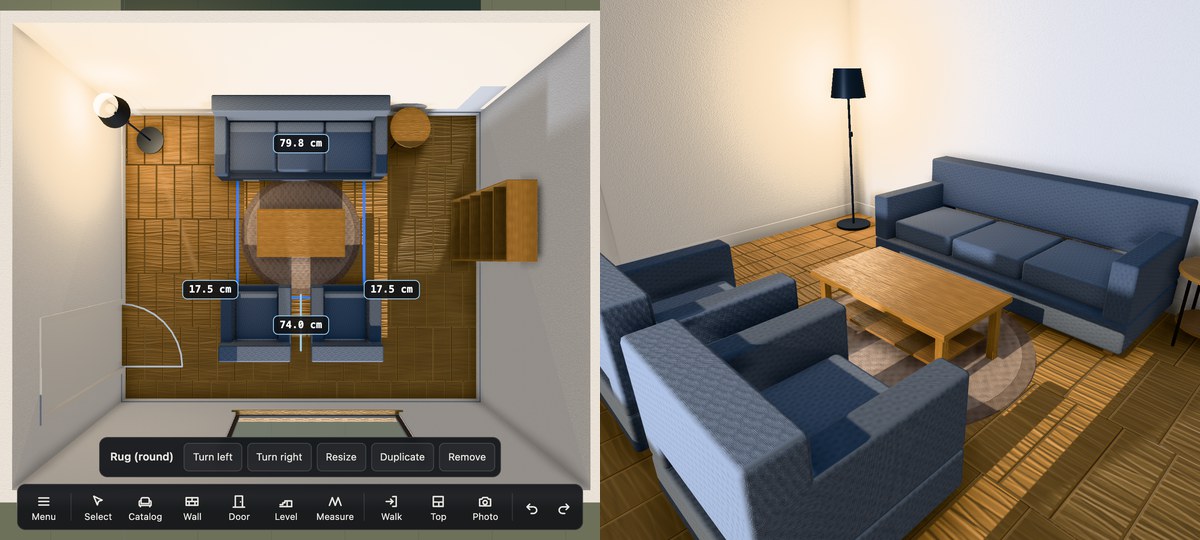
A round rug of 160 cm across fits round the coffee table with 25 cm to spare at each end of it. Like the 200 × 140, it touches none of the seats. Round rugs work best under a round table or in front of a single chair; under a long sofa they leave the corners of the room looking empty.
The sum, for your own room
- Measure the seating group: from the back of the sofa to the backs of the chairs opposite, and the width of the sofa.
- For the front legs on: the rug's depth is the distance from 20–30 cm under the sofa's front to 20–30 cm under the chairs' fronts.
- For its width: the sofa plus 15–40 cm at each end.
- Then check what is left to the walls. Here 55 to 90 cm. If there is almost nothing left, step down a size.
Try it
- Draw the room or open your plan, press O for the view from above and open Catalog.
- Place your sofa, chairs and table. Then search for rug and place Rug (rectangular) under the table.
- Select the rug, press Resize and type the size you are looking at, for example 290 by 200.
- Read the gaps round it, then try Rug (round) in its place.
- Double-click the floor by the door and look at the room as you will see it.
Limits worth knowing
- The rug's pattern and colour are the app's own; use it to judge the size, not the look of the rug you will buy.
- A selected rug's readings go to the nearest thing in each direction, which can be a chair standing on it rather than the wall. Measure to the wall where it matters.
Questions people ask
What size rug for a three-seater sofa?
For a sofa of about 210 cm with chairs opposite, a 200 × 290 cm rug lets the front legs of all the seats stand on it with room to spare. A 160 × 230 rug only just reaches both, by 10 to 14 cm.
Should the sofa legs be on the rug?
The front legs, yes, if the rug is meant to hold the group together: 20 to 30 cm under the front is enough. A rug that stops short of the sofa reads as a mat under the table.
How far should a rug be from the wall?
Leave a border of bare floor. In the 4.8 × 3.9 m room here, 55 to 90 cm looked right. Less than about 20 cm starts to look like a carpet that did not quite fit.