
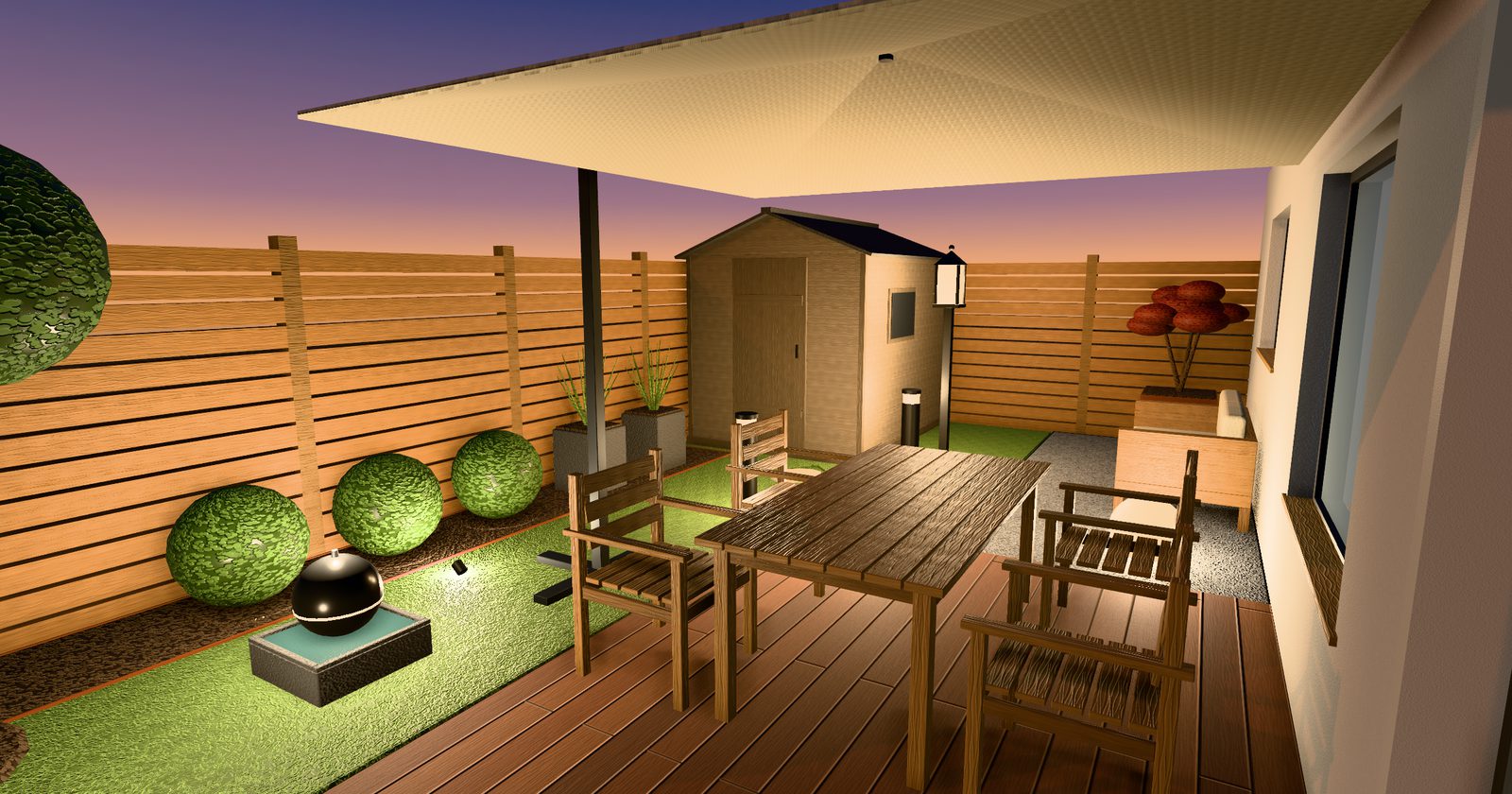
Garden lighting plan: show it at dusk, then quote it
The first evening after the job
The lighting plan was approved on paper: a row of symbols along the border, two by the path, one by the shed. The first evening after the job, the client sits down at the table and the spot meant for the tree shines into their eyes. The path between the two bollards is dark exactly where the step is. Nothing is wrong with the fittings. The plan was simply never seen at dusk.
Lighting is the part of a garden design a client can least imagine from a drawing, and the part they notice first after it is built. This post shows how to put a lighting plan in front of a client at dusk with Duimstok, and how to read the fittings off the same design for the quote.
Eight fittings for a 44 m² garden
The garden here is 9.10 × 4.80 m: a deck with a table by the house, a lawn, a planting bed along the back fence, gravel and a sofa on one side, a shed in the corner. It is lit with eight fittings, each with a job:
- Two spike spotlights: one under the tree, one on the box balls in the bed. They give the garden its depth.
- Two bollards and a solar path light: along the lawn and the stepping stones, where people walk.
- A globe light on the gravel by the sofa, for a soft glow rather than a beam.
- A lantern post by the shed, so the far corner is a place, not a dark gap.
- The water feature, which carries its own light.
That is about one fitting for every 5.5 m². A useful check, not a rule: a garden with far fewer usually has a dark middle, and one with many more starts to look like a car park.
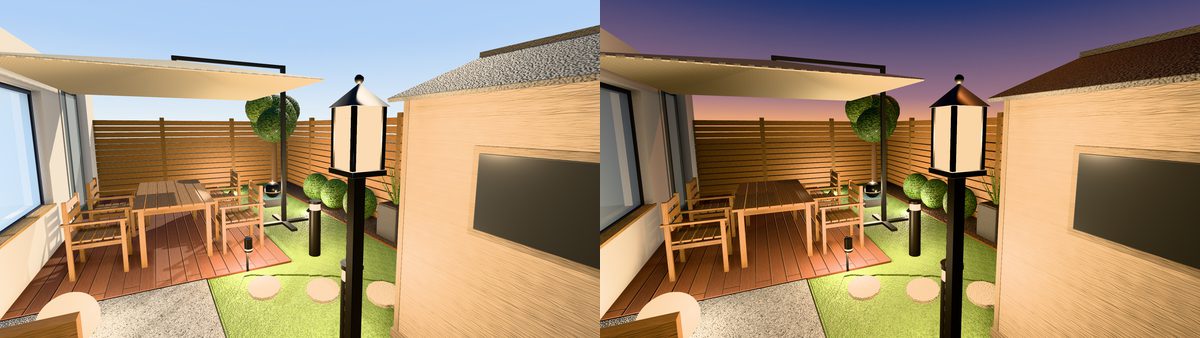
What dusk shows that a plan does not
Three things a client sees at once in the evening view, and never on paper:
- Glare. A spot aimed across the garden ends up in someone's eyes at the table. Turn it, or move it to the other side of the plant.
- Dark gaps. Two bollards 3 m apart leave the middle of the path unlit; a step there is a trip.
- Balance. A bright lantern at the far end pulls the eye away from the terrace. Sometimes that is the point; sometimes it should be dimmer.
Each one is a five-minute change in the design, and a day's work after the cable is in.
Read the fittings off the design
Every fitting in the design is a line in Quantities: here 2 bollards, 2 spike spotlights, 1 globe, 1 lantern post, 1 solar path light and 1 water feature, beside the m² of decking, gravel and lawn. With your own prices in Quote, the fittings become lines on the quote from the same design the client walked through, so what they approved at dusk is what they pay for.
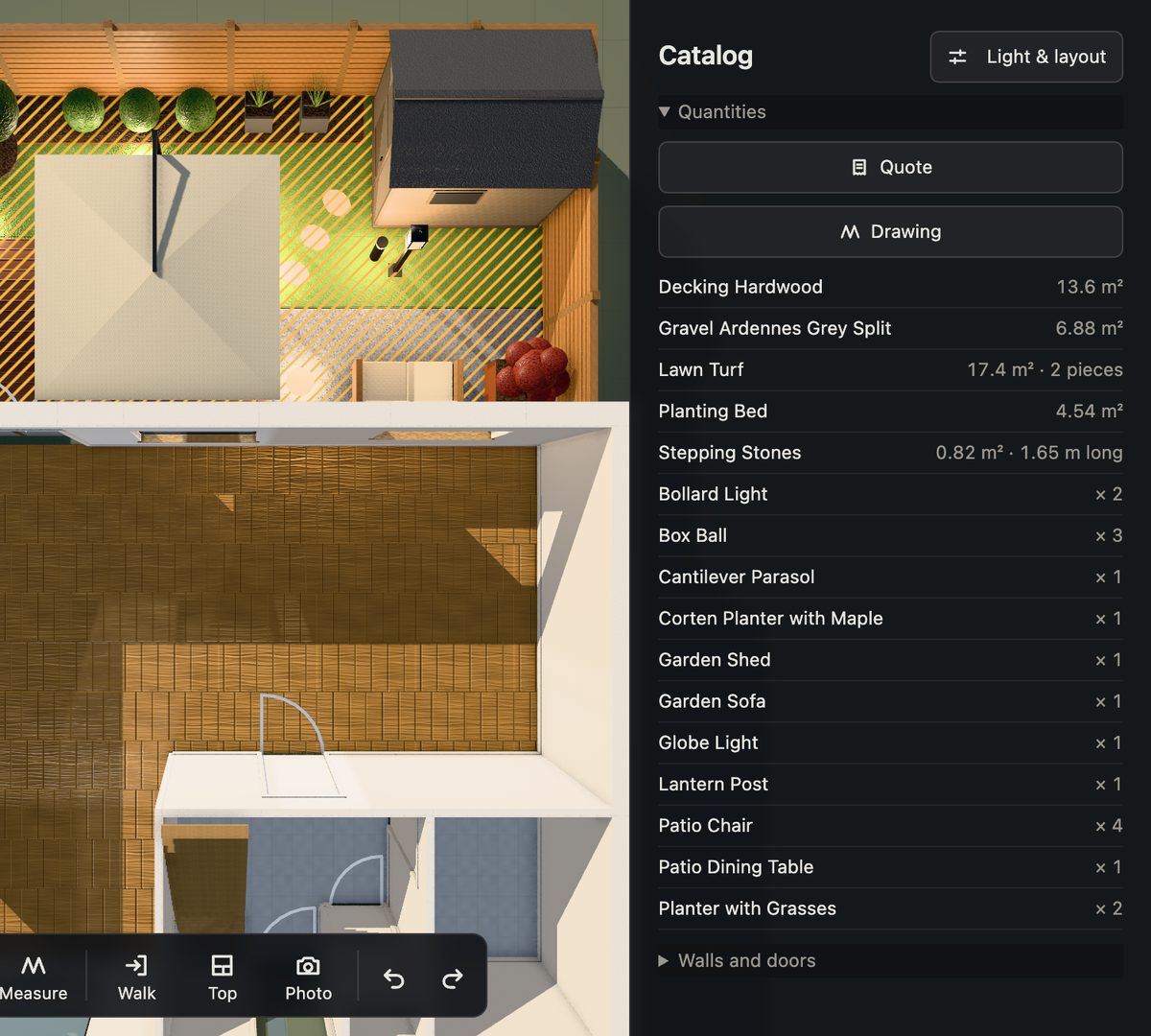
Try it
- Open Catalog and search for light: place Spike Spotlight, Bollard Light, Lantern Post and the others where you would put them.
- Click a spike spotlight and press Turn left or Turn right to aim it at the plant.
- Press Evening in the catalogue, then Walk, and sit where the client sits.
- Open Catalog, then Quantities, to count the fittings; add your prices in Quote.
Limits worth knowing
- Duimstok lights up to eight lamps in one design. A ninth is placed and counted but stays unlit, so plan the main ones first.
- It shows where light falls; it does not plan cables, transformers or circuits. That stays with the electrician.
- The light is a good impression, not a lux calculation.
Questions people ask
How many lights does a small garden need?
A garden of about 45 m² is often lit well with six to ten fittings: a few accents on plants, a few along the path, and one or two for the seating.
How do you show a client a lighting plan?
Let them see it at dusk, at eye height, from where they will sit. A plan with symbols shows where the fittings are, not what they do.
How far apart should path lights be?
Close enough that the light of one reaches the next: for low bollards that is often 2 to 3 m. Check it in the evening view.