
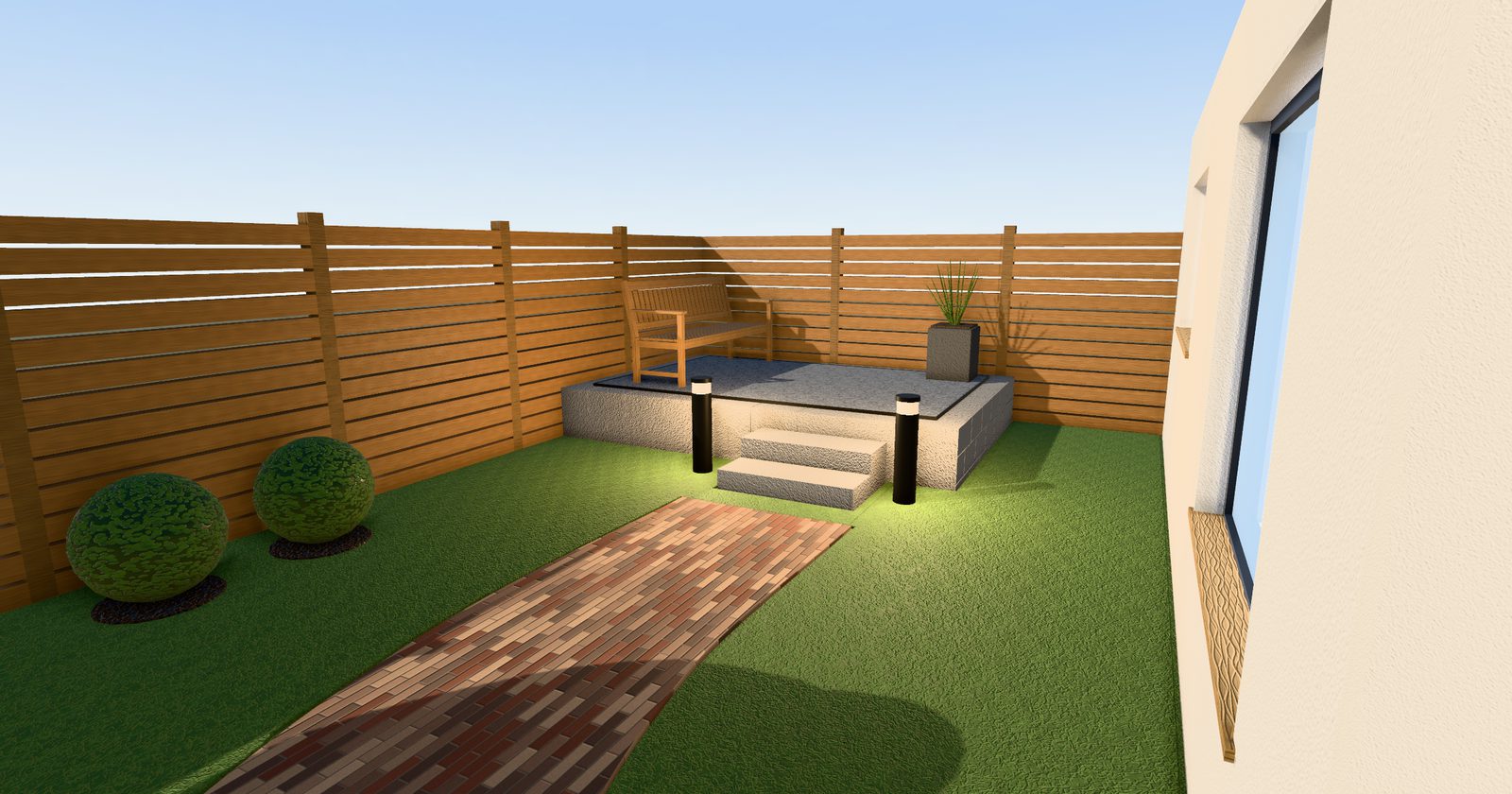
How wide should a garden path be? 60, 90 or 120 cm
The path that shrank
On the plan it looked generous: a neat curve of pavers from the back door across the lawn, 60 cm wide. In April it was fine. By July the lavender leaned in from one side and the lawn edge crept in from the other, the wheelbarrow had to go across the grass, and nobody walked to the end of the garden side by side any more.
A path's width is the one number nobody can feel on a drawing. This post goes through what 60, 90 and 120 cm each allow, what each costs in paving on a real path, and how to walk yours before anyone sets out a string line, using Duimstok.
What each width allows
- 60 cm: one person at a time. Enough for a service path behind a shed or stepping stones through a border, tight for anything you carry or push. A garden wheelbarrow is about 60 to 70 cm across.
- 90 cm: one person comfortably, with a wheelbarrow, a bin or a bag of shopping. The width most garden designers start from for the main path.
- 120 cm: two people side by side, which is what you want on the way from the house to where you sit.
Then take off what grows over it. Plants along a path usually lean in 10 to 20 cm by midsummer, on each side that has a border. A 90 cm path between two borders walks like a 60 cm one by July.
What each width costs in paving
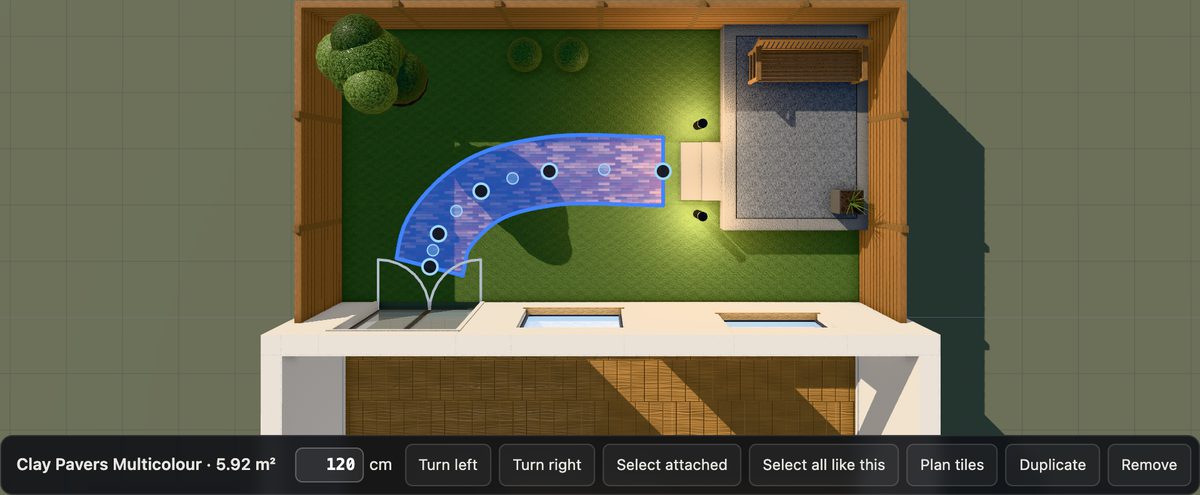
Paving is bought and laid by the square metre, so the width multiplies straight into the price. The path in the pictures curves from the garden doors across the lawn to the steps of a raised terrace, about 5 m along its middle. Duimstok measured it at each width:
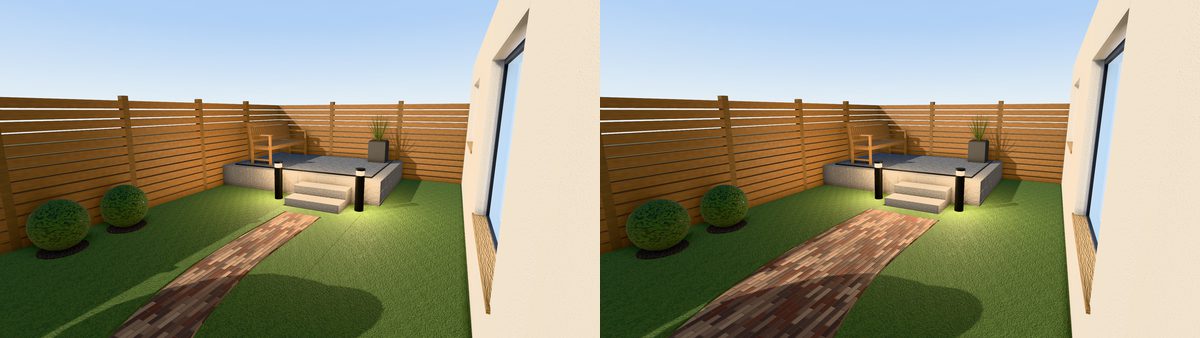
- 60 cm: 3.14 m², 5.23 m long
- 90 cm: 4.57 m², 5.08 m long
- 120 cm: 5.92 m², 4.93 m long
Every 30 cm of width is roughly another 1.4 m² of pavers, sub-base and edging work on this path, and on a path twice as long it is twice that. The narrower paths come out a little longer because their middle line starts closer to the door. That is also why a curved path is where guessing goes wrong: its length is measured along its middle, and the inside of a curve is shorter than the outside.
Walk it before you lay it
In Duimstok a path is drawn from above, point by point, through the places it passes: pick a paver in the catalogue, choose Path on the bar, and click. Select the path and its width is on the bar; type 90 instead of 120 and the whole curve narrows, and the square metres change with it.
Then double-click by the garden doors and walk it at eye height. That is where 60 cm shows itself: you see at once whether the path looks like the way to somewhere or a strip of edging. Walk it with the borders planted and the lawn on either side, the way it will be in summer.
Make it meet the steps
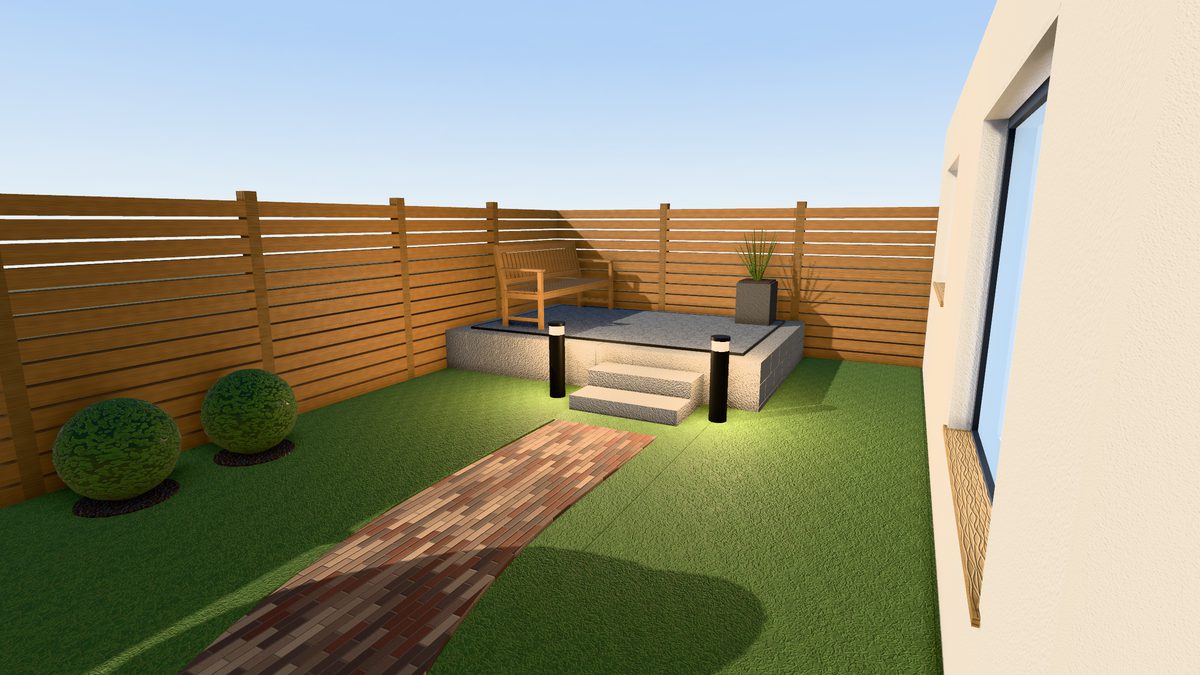
This path ends at three steps up to a gravel terrace raised 45 cm along the side fence, a level in Duimstok. You draw the level, type 45 for its height, choose its retaining wall, and press Steps: the app works out the flight from the height, three risers of 15 cm, and builds it 1 m wide.
So the width of the path and the width of the steps should be decided together. A 60 cm path that arrives at a 1 m flight looks like an afterthought; a 120 cm path that narrows to 1 m reads as an entrance. At 90 cm the two line up almost exactly.
Try it
- Open the plan of your garden and press O for the view from above.
- Open Catalog, pick a paver or a gravel, and choose Path on the bar.
- Click the points the path passes through, Shift-click for a sharp corner, and press Enter or Done to finish.
- Select the path, type its width in centimetres on the bar, and read its square metres.
- Double-click by the door and walk it. Change the width on the bar and walk it again.
Questions people ask
What is the minimum width for a garden path?
60 cm for one person on foot. For a main path that takes a wheelbarrow, 90 cm; for two people side by side, 120 cm.
How wide should a path be for a wheelbarrow?
At least 90 cm. A garden wheelbarrow is about 60 to 70 cm across, and you need room for your hands and to steer.
How do I work out how much paving a curved path needs?
Multiply its length along the middle by its width. Duimstok measures a path you draw for you: the 5.08 m path here, 90 cm wide, is 4.57 m².
Should garden steps be as wide as the path?
About as wide or a little narrower. Steps much narrower than the path look like an afterthought; much wider look like a stage.