
Bank or retaining wall? Price both from one level
"Can we do it without a wall?"
You have drawn the back of the garden 45 cm up, with a block wall and three steps, and the client likes it until the quote. Then the question comes: could the lawn just slope down instead? It sounds cheaper, and softer. It is often both, but a slope takes room, and on a terrace 2.5 m deep the room is the point.
Here is the same raised level built three ways in Duimstok: a concrete block wall, a lawn bank and a planted bank, with what each one takes from the garden and what it puts on the quote.
The level: 9.10 × 2.50 m, 45 cm up
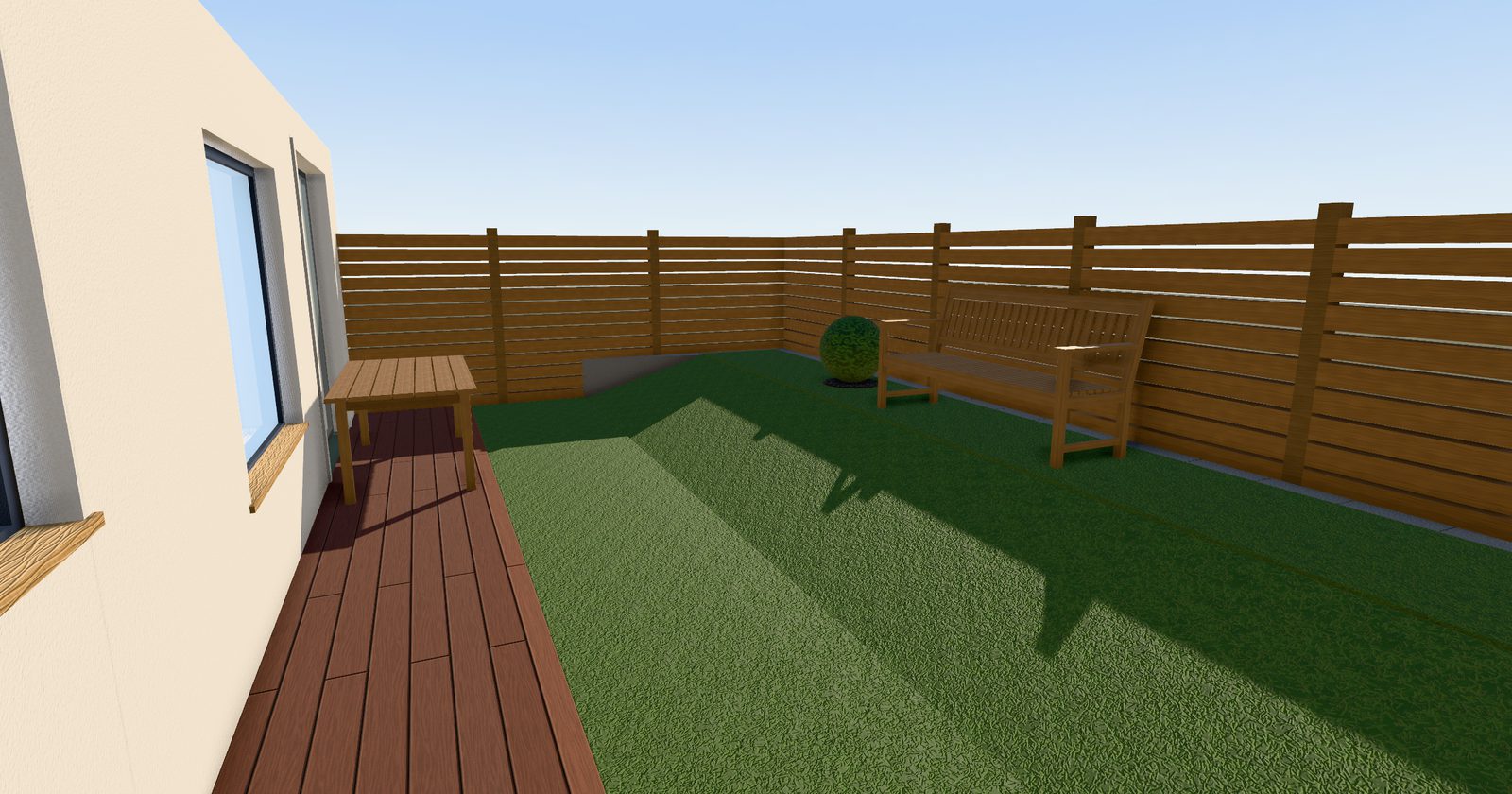
The garden is the 9.10 × 4.80 m back garden we use for every example. The back 2.50 m is raised 45 cm across the full width: a lawn on top with a bench and a box ball, the house, the deck and a lower lawn in front.
Along the three fences the level is held by concrete blocks in every version. Only the open front, the 9.10 m facing the house, changes. Since v1.0.9, Duimstok lets one side of a level take its own wall, so that is a single choice on that side.
Version one: a block wall and steps
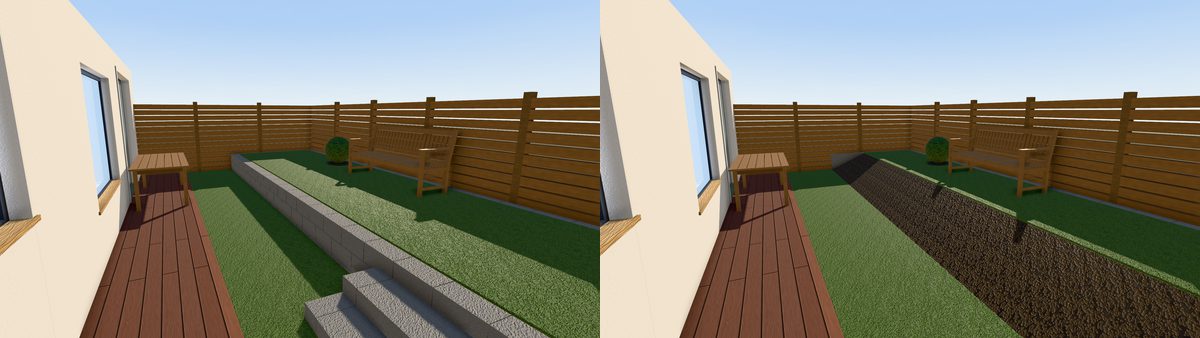
The front is a grey concrete block wall with a flight of two steps, 120 cm wide. The wall takes almost nothing from the terrace: the lawn on top runs to its edge, nearly the full 2.50 m deep.
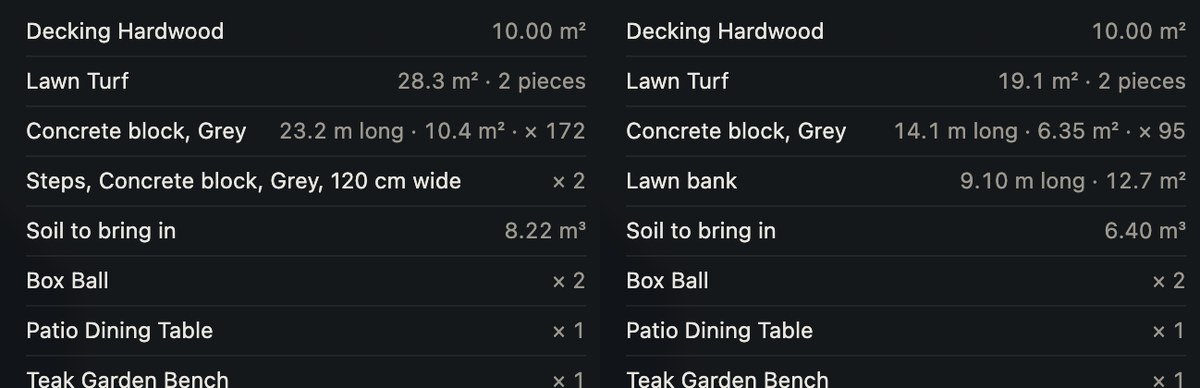
The Quantities list counts the walls off the layout the app builds, block by block: 172 blocks for all four sides, 23.2 m long and 10.4 m² of face, plus the two steps, and 8.22 m³ of soil to bring in to raise the lawn.
Version two: a lawn bank at 1:3
Grass is mown on slopes up to about 1 in 3, and that is the gradient of Duimstok's lawn bank. To come down 45 cm at 1:3 the slope needs 1.35 m of ground, and it takes that from the top of the level, where a wall would stand. The flat lawn on top shrinks from about 2.5 m deep to 1.15 m. The bench still fits; a table with chairs round it would not.
On the quote, the front wall is gone: the blocks drop from 172 to 95, for the three fence sides alone. That is 77 blocks, 9.1 m of wall and two steps fewer. The soil drops to 6.40 m³, because the slope is a wedge of earth rather than a full block of it. And there is a new line: Lawn bank, 9.10 m long, 12.7 m², which is the turf you lay on the slope. A slope is longer than its plan, so the turf goes up, from 28.3 m² of lawn to 19.1 m² of flat lawn plus 12.7 m² of bank.
Version three: a planted bank at 1:2
A bank that is planted, not mown, can be steeper. Duimstok's planted bank is 1:2, so the same 45 cm takes 90 cm and leaves 1.60 m of flat lawn on top. It lists as Planted bank, 9.10 m long, 8.96 m², the area you plant, with 7.27 m³ of soil to bring in. Ground cover, low shrubs or grasses on a slope that faces the house make a front edge that never needs a mower.
The trade, side by side
- Block wall and steps: about 2.5 m of flat lawn on top, 172 blocks, 8.22 m³ of soil.
- Lawn bank, 1:3: 1.15 m of flat lawn, 95 blocks, 6.40 m³ of soil.
- Planted bank, 1:2: 1.60 m of flat lawn, 98 blocks, 7.27 m³ of soil.
Read it with the client. The bank saves a front wall and the steps, and the lorry brings less soil. In return the terrace on top loses up to 1.35 m. On a deep plot, or where the top is just a strip of lawn, the bank usually wins. Where the client wants to sit up there with a table, the wall earns its price.
Show both, then let them choose
The quickest way through the question is to show both. Switch the front side from wall to bank, walk out of the garden doors with the client, and look at the slope; then switch back. The numbers on the quote change as you do.
Try it
- Open your plan, press O for the view from above and draw the raised area with Level, then type its Height on the bar.
- Choose the Wall type for the level, for example concrete block.
- Press Side on the bar and click the front side, then choose Lawn bank or Planted bank as its wall type.
- Press Walk and look at the slope from the garden doors.
- Open Quantities for the blocks, the bank and the soil, and add your prices in Quote.
Limits worth knowing
- The two banks have fixed gradients: 1:3 for lawn and 1:2 for planting. A gentler slope is not offered yet.
- Soil is counted as it lies in the ground, with no allowance for settling or bulking; your supplier may add some.
- The app does not judge ground conditions or drainage. Whether a bank holds on your soil is for you to decide on site.
Questions people ask
How steep can a grass bank be?
Landscape guidance generally puts the limit for mowing at about 1 in 3, with 1 in 4 more comfortable. At 1:3, a 45 cm change of level needs 1.35 m of slope.
Is a bank cheaper than a retaining wall?
Here it saved 77 blocks, two steps and 1.82 m³ of soil, but it added 12.7 m² of turf on the slope and took 1.35 m off the terrace. Price both from the same design to see it for your job.
How much space does a garden bank need?
The height times the gradient: 45 cm at 1:3 is 1.35 m, at 1:2 it is 90 cm.